Patuxay
Patuxay
At the end of Lane Xang Avenue, Patuxay blends Parisian inspiration with Laotian motifs. History, architecture and practical advice for your visit.
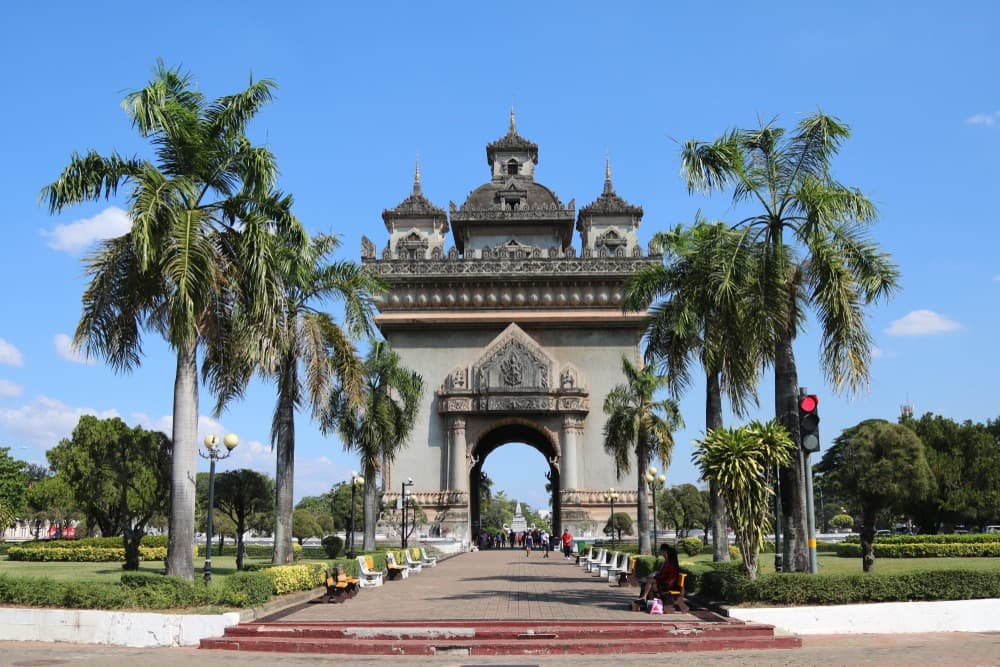
At the far end of Lane Xang Avenue, the Patuxay stands as the monumental heart of Vientiane. Inspired by Paris's Arc de Triomphe yet adorned with Laotian motifs, this 45-meter-tall monument commemorates those who fell for the nation's independence. Its imposing silhouette, four arches and observation platform make it one of the capital's most visited landmarks.
Why visit Patuxay
The Patuxay embodies several facets of Vientiane in a single place: the legacy of the French colonial period, the assertion of post-colonial Laotian identity, and the everyday life of a tranquil capital. The surrounding park, dotted with fountains and shaded benches, serves as a gathering point for locals as evening falls.
For visitors, the monument invites multiple readings: architectural (a blend of Parisian codes and traditional motifs), historical (memory of war and independence) and panoramic (views over the city and the Mekong from the summit).
History of the monument
Patuxay was built between 1960 and 1969 from designs by Laotian architect Tham Sayasthsena. A persistent anecdote surrounds its construction: the materials, particularly cement, were reportedly acquired through American funds originally earmarked for an airport, earning the monument its unofficial nickname of the "vertical runway." Local guides frequently recount this story, though the line between fact and legend remains difficult to draw.
The monument was erected to commemorate those who died in conflicts accompanying Laos's path to full sovereignty, a process initiated by Franco-Laotian agreements in the early 1950s and achieved in the latter half of the decade. After the Pathet Lao seized power in 1975, a victory parade held in Vientiane established the site's current name, also known as the "Gate of Triumph" or "Gate of Victory."
What to see on site
The exterior and park
The monument stands 45 meters high and 24 meters wide. It opens through four gates, each framed by a pond. A small sala in the park houses the World Peace Gong, installed in 2008 as part of an international program bringing together several world capitals.
Both on the facade and beneath the arches, sculptures blend Laotian Buddhist motifs with figures from Hindu mythology, decorated with ceilings featuring mythological creatures.
The interior
The building spans seven levels, with the lower floors housing souvenir shops and occasional exhibitions on Laotian history and cultures. On the ground floor, the vault of the four arches is adorned with Buddhist and Hindu motifs. Inside are representations of Vishnu, Brahma and Indra, arranged from left to right.
The towers and the view
Five towers crown the edifice in traditional Laotian style, with floral motifs and gilded ornaments. A spiral staircase in the central tower leads to the observation platform, from which you can take in Lane Xang Avenue, central Vientiane, and on clear days, the banks of the Mekong in the distance.
The musical fountain
Facing the monument, a musical fountain built with Chinese assistance operates in sequences as evening approaches. It's one of the beloved gathering spots for Vientiane families.
Practical information
- Access to the summit: a modest admission fee is charged to climb to the observation platform. Park access is free.
- Duration of visit: allow 45 minutes to 1.5 hours depending on whether you ascend to the summit and stroll through the park.
- Hours: open during daylight hours, seven days a week, with a possible break midday. Hours vary; check on arrival.
- Dress code: no strict dress code, though modest clothing is appreciated in the context of the World Peace Gong.
When to visit
Patuxay is worth visiting year-round. The dry season (November to February) offers the most pleasant conditions, with moderate temperatures and clear skies ideal for panoramic views. The hot season (March-April) makes climbing the seven levels uncomfortable midday; prefer late afternoon instead.
Sunset remains the most rewarding time for many visitors, followed by the monument's nighttime illumination and the musical fountain sequences.
How to get there
Patuxay sits at the end of Lane Xang Avenue (Thanon Lane Xang), about five blocks northeast of the Presidential Palace. Several options:
- On foot: from the historic center and Mekong riverside, allow 20 to 30 minutes walking up the avenue.
- By bicycle: rental is easily available in Vientiane and the flat terrain is ideal for cycling.
- By tuk-tuk: a common option from anywhere in the city; negotiate the fare before boarding.
Nearby attractions
Patuxay fits naturally into a day of exploring Vientiane. To extend your Laotian experience beyond the capital, several sites complement a well-rounded itinerary:
- Mai Savanh Lao, for an introduction to fair-trade craftsmanship in Laos.
- Blue Lagoon, for a nature stop around Vang Vieng.
- Mekong Eden Farm, to discover local agriculture along the river.
- TAEC – Ethnology and Traditional Arts, to delve deeper into the country's cultural diversity.
Frequently asked questions
Frequently asked questions
According to an anecdote widely told in Vientiane, the materials used for its construction came from American funds originally earmarked for an airport, hence this unofficial nickname.
Yes. A spiral staircase in the central tower leads to the observation platform for a modest admission fee. The view spans Lane Xang Avenue and central Vientiane.
From 45 minutes for a quick stop to 1.5 hours if you climb to the summit, explore the park and wait for the musical fountain.
Late afternoon is most pleasant: the heat subsides, light brings out the golden motifs beautifully, and you can go straight into evening illumination and the musical fountain.
It draws inspiration but stands distinct: it's slightly taller, has four gates instead of two, and features traditional Laotian motifs along with Buddhist and Hindu references.
Plan your trip
Patuxay is a natural stop on any visit to Vientiane. To build a complete itinerary combining the capital, Luang Prabang, the Bolovens Plateau or the Mekong, explore our Laos travel suggestions.
Nearby
Interested in this visit?
We can include it in your personalised itinerary.