Vat Phou
Vat Phou
Vat Phou is a complex of pre-Angkorian Khmer temples perched on Mount Phou Kao, near Champassak. UNESCO-listed since 2001, it features refined sculptures, a sacred spring, and panoramic views over the Mekong.
Vat Phou is a complex of Khmer temples nestled on the foothills of Mount Phou Kao, some twenty kilometres south of Champassak. Built between the 5th and 13th centuries, it predates Angkor Vat and stands as one of Southeast Asia's finest preserved religious ensembles. Inscribed as a UNESCO World Heritage site since 2001, the site blends Khmer architecture, Shaivite worship, and forested mountain landscape.
Quick reference
- Entrance: paid admission (tickets available at the site entrance)
- Recommended duration: 2 to 3 hours to explore the entire complex
- Dress code: shoulders and knees covered recommended — the site remains active for certain ceremonies
- Access: tuk-tuk or bicycle from Champassak; boat crossing of the Mekong from Pakse possible
- Best season: dry season (November to April) for passable paths and clearer vegetation
What to see
The complex unfolds along an east-west axis connecting the Mekong to the main sanctuary. Two rectangular basins frame the entrance avenue, once used for purification rituals. Gopuras (monumental gateways) punctuate the ascent towards the upper temple, whose carved lintel depicts Shiva. A sacred spring flows directly behind the sanctuary, symbolically nourishing the entire site.
History and context
The site was founded in the pre-Angkorian period, under the Khmer empire, as a place of worship dedicated to Shiva. Mount Phou Kao is identified with Mount Meru, the abode of the gods in Hindu cosmology. Following the decline of the Khmer empire, the site was gradually converted to Theravada Buddhism, a religious layer still visible in the Buddha statues added to the original structures.
Highlights of the visit
The basins and processional avenue
From the entrance, two grand basins flank the central axis. Their laterite banks host dense vegetation. Early in the morning, mist over the water and raking light create a particularly evocative atmosphere.
The ascent to the upper sanctuary
A stone stairway, bordered by carved nāgas, leads to the main temple. The slope is moderate but steady. Midway, ruined pavilions offer vistas across the Mekong plain.
The main sanctuary and sacred spring
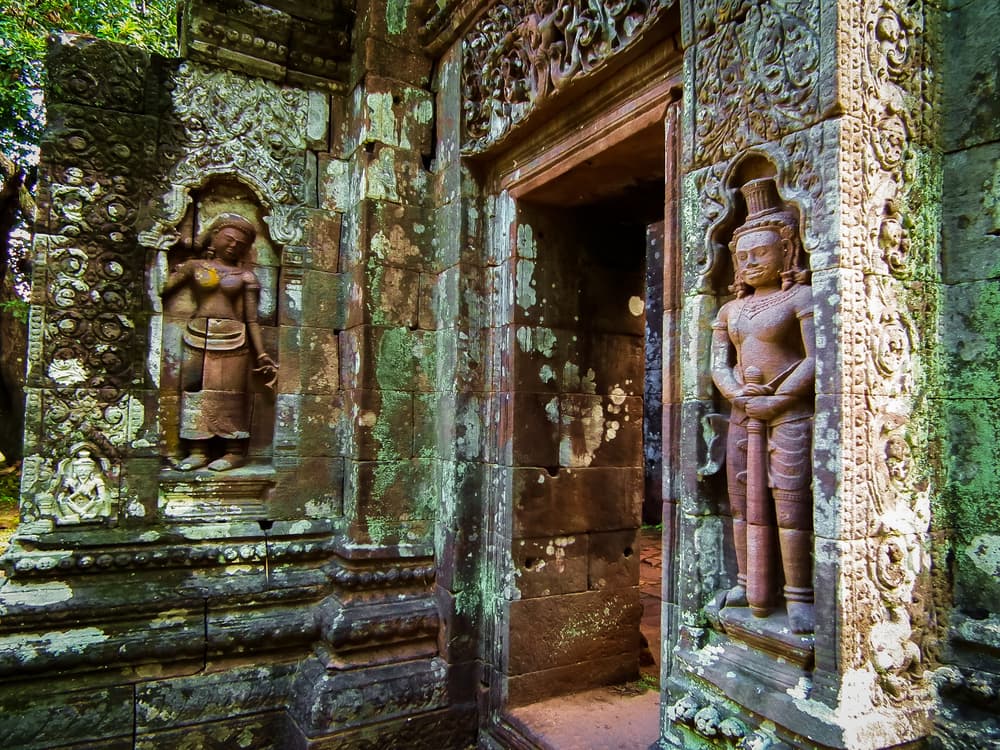
The upper temple preserves finely carved lintels depicting mythological scenes. Behind the sanctuary, a natural spring filters through the rocks — a focal point for offerings and prayers to this day.
The view over the plain and Mekong
From the upper level, the gaze sweeps across rice paddies, the Mekong's meanders, and the river islands. It is one of the widest panoramas in the Champassak region.
Etiquette and visiting rules
- Cover shoulders and knees before entering active worship areas.
- Remove shoes before entering the main sanctuary.
- Do not touch or climb on sculptures and lintels.
- Speak softly near altars and offerings.
- Ask permission before photographing monks or worshippers at prayer.
Photography tips
Morning light (before 9 a.m.) is ideal: it illuminates the basins head-on and avoids harsh shadows on the sculptures. In late afternoon, the setting sun gilds the laterite stones of the upper sanctuary. Carved lintels photograph best with a standard or slightly telephoto lens to isolate detail. Photography is permitted across nearly the entire site; check signage at the inner sanctuary entrance.
Location and access
Vat Phou sits approximately 45 km south of Pakse, on the west bank of the Mekong, near the village of Champassak. From Pakse, the road hugs the river; allow about an hour by car or tuk-tuk. Slow boats also link Pakse and Champassak during high-water season. The site is not wheelchair accessible due to stone staircases.
Nearby attractions
- Pakse — the region's main city and departure point for the Bolaven Plateau and Mekong islands.
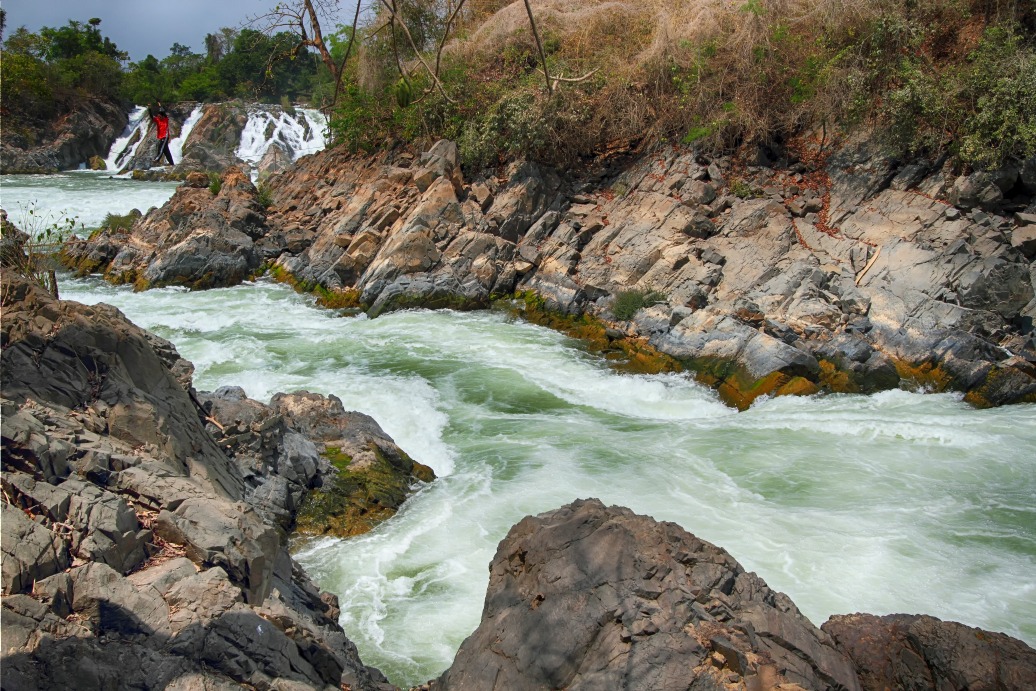
- Si Phan Don (4,000 Islands) — a river archipelago south of Champassak, known for its rapids and Irrawaddy dolphins.
- Bolaven Plateau — highlands east of Pakse, coffee plantations and waterfalls accessible by motorcycle.
Frequently asked questions
The dry season, from November to April, offers passable paths and less dense vegetation. February often coincides with the Vat Phou festival, a lively time though more crowded.
Yes. Shoulders and knees covered are required in active worship areas. Bring a sarong or lightweight shawl if you are wearing short clothing.
Hardly in a single day. Vat Phou deserves 2 to 3 hours on-site; Si Phan Don lies further south. Plan at least two days to comfortably visit both sites.
Photography is generally allowed throughout the complex. Certain interior areas of the sanctuary may display restrictions; respect any signage in place.
By tuk-tuk or rental car from Pakse via the road hugging the Mekong (approximately one hour). A slow boat from Pakse to Champassak is possible during high-water season, then a tuk-tuk to the site.
No. Unmodified stone staircases make access to the upper sanctuary impossible by wheelchair. The basins and lower avenue remain accessible on foot over level ground.
Interested in this visit?
We can include it in your personalised itinerary.