Xieng Khuan, the "Buddha Park"
Xieng Khuan, the "Buddha Park"
Located 25 km from Vientiane, Xieng Khuan brings together over 200 concrete Buddhist and Hindu sculptures, the work of a priest-shaman initiated in 1958.
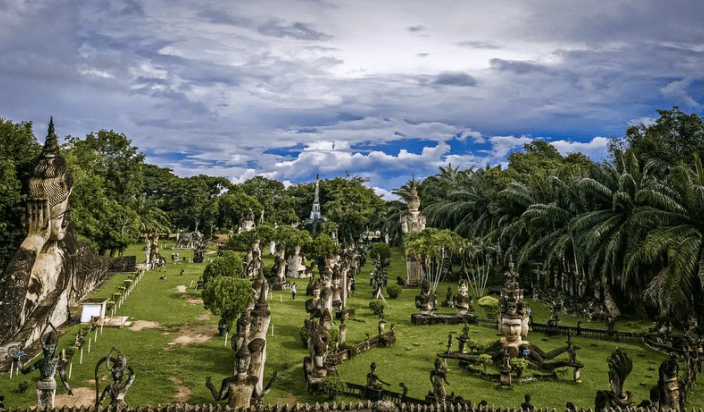
Xieng Khuan, whose name means "the city of spirits," is a sculpture park located about twenty kilometers southeast of Vientiane, on the banks of the Mekong River, which marks the border between Laos and Thailand. Better known as the Buddha Park, the site houses over 200 concrete statues blending Buddhist and Hindu iconography, the result of a single man's vision in the late 1950s.
Why visit Xieng Khuan
The park is one of the most accessible excursions from Vientiane and one of the rare places in Southeast Asia to present, on the same grounds, Buddhist and Hindu deities on a grand scale. The coexistence of Avalokiteshvara, Shiva, and Vishnu is no coincidence: it reflects a personal vision of religious syncretism carried out by the site's founder.
The location appeals equally to travelers curious about Asian religious art and those seeking a half-day away from the capital. The grassy terrain, bordered by the river, is easily explored on foot at a leisurely pace.
History of the park
Xieng Khuan was constructed in 1958 by Luang Pu Bunleua Sulilat, a priest-shaman with a remarkable life journey. Influenced by his encounter in Vietnam with a rishi (Hindu sage), he set out to unite Buddhism and Hinduism in a single sacred space—two traditions that have often been at odds throughout history. The park was designed as the physical embodiment of this syncretic ambition.
In 1975, following the Pathet Lao's seizure of power, Bunleua Sulilat fled Laos and crossed the Mekong to settle in Thailand, in Nong Khai province. There he built a sister park, Sala Keoku, which extends the vision he had left behind. The two sites face each other across the river: on clear days, the tallest statues of one are visible from the other.
What to see on the site
The sculptures are made of reinforced concrete, but their patina often gives the impression of works centuries old. The range of subjects is deliberately broad: human and divine figures, animals, demons, bodhisattvas. You will encounter representations of Avalokiteshvara and, on the Hindu side, two members of the Trimurti, Shiva and Vishnu.
The "giant vegetable" with three levels
The park's most striking sculpture resembles a large spherical fruit or vegetable. It is organized into three tiers symbolizing Hell, Earth, and Heaven. Entry is through the mouth of a demon, whose head measures over three meters high. Inside, staircases connect the levels, each adorned with scenes appropriate to its symbolism.
The reclining Buddha
The other centerpiece is an imposing Buddha reclining on its side, measuring over 40 meters in length according to local sources. Its form dominates the southern section of the park and remains visible from the Thai riverside.
Strolling and photography
The park invites free exploration. Statues are scattered across a vast lawn with no prescribed path, leaving time to photograph from different angles and observe sculptural details.
Practical information
- Duration of visit: allow 1 to 2 hours to walk around, more if you take time to enter the "giant vegetable."
- Admission: modest entry fee in kips, with a symbolic surcharge for cameras depending on the period.
- Hours: daytime opening, generally from morning through late afternoon.
- Comfort: little shade; bring water, a hat, and closed-toe shoes if you plan to climb into the hollow sculpture.
When to visit
The park is open year-round, but the dry season, from November to March, offers the most comfortable conditions: moderate temperatures, low humidity, and accessible terrain. From April to May, midday heat can be challenging; an early morning visit is preferable. During the rainy season (June to October), showers are brief but heavy: a morning visit remains the safest option.
How to get there
The park is located approximately 25 km southeast of Vientiane, near the village of Dongphosy, along the Mekong. Several options are available:
- Local bus: line 14 from the morning market (Talat Sao) in Vientiane serves the park.
- Tuk-tuk or taxi: a faster solution, to be negotiated for round-trip with waiting time on site.
- Car or scooter: head southeast from Vientiane following the Mekong to Dongphosy, then continue on the local road leading to the park.
Nearby attractions
A visit to Xieng Khuan naturally fits into a broader exploration of the capital and its surroundings:
- Vientiane and its temples, the logical starting point for the excursion.
- Chao Anouvong Park, a green space on the Mekong's banks in the city center.
- Phou Khao Khouay National Park, for a nature day east of Vientiane.
Frequently asked questions
Frequently asked questions
Xieng Khuan means "the city of spirits" in Lao. The site is better known to travelers by the name "Buddha Park."
No. They were created from 1958 onward in reinforced concrete. The patina and sculptural style give them an ancient appearance, but the entire park dates from the second half of the twentieth century.
Allow 1 to 2 hours on site, plus travel time from Vientiane. A half-day is ample for a round-trip with a leisurely visit.
Yes. Access is through the mouth of a sculpted demon at the entrance. Internal staircases connect the three levels representing Hell, Earth, and Heaven.
Yes. Sala Keoku, in Nong Khai province, was built by the same founder after his exile in 1975. The two parks face each other across the Mekong.
Include Xieng Khuan in your journey
Xieng Khuan combines easily with a stop in Vientiane, at the beginning or end of your itinerary. To incorporate this visit into a more comprehensive travel plan, explore our trips to Laos designed with local specialists.
Interested in this visit?
We can include it in your personalised itinerary.