Nam Et
Nam Et
A 410,720-hectare reserve in northeastern Laos, sanctuary of the Indochinese tiger, accessible via Muang Hiam for river safaris and guided treks.
Nam Et-Phou Louey National Park spans 410,720 hectares across northeastern Laos, straddling the provinces of Houaphan, Luang Prabang, and Xieng Khouang. Its name combines those of the Nern and Et rivers and Phou Louey mountain, translated as "Eternal Mountain." This protected area ranks among Southeast Asia's rare sanctuaries where the Indochinese tiger and gaur still survive, and access is organized from the town of Muang Hiam.
Why visit Nam Et-Phou Louey
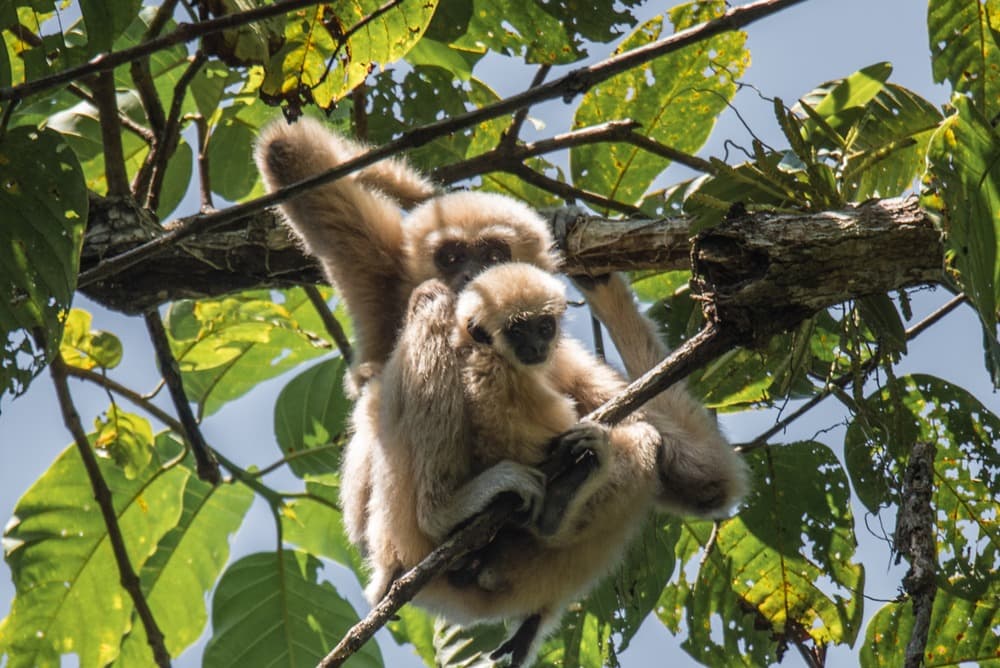
The park stands out for three tangible elements. First, its scale: 410,720 hectares spanning seven districts and three provinces, with altitudes ranging from 300 to 2,300 meters. Next, its wildlife: it is one of the last refuges of the Indochinese tiger in Laos, alongside the gaur, the white-cheeked crested gibbon, the Sambar deer, and several otter species. Finally, its community-based tourism model: visits directly contribute to the income of riverside villages, which in turn commit to wildlife protection.
Unlike other, more accessible Lao parks, Nam Et-Phou Louey remains little frequented. Tours are guided, in small groups, and economic returns for communities partly condition their engagement against poaching.
What to see and do
Flora and fauna
Inventories document 314 plant species in the park, including 18 used for construction, 26 in traditional medicine, and 92 in local cuisine. Forest cover blends primary forest, secondary formations, and shrubby zones, the latter accounting for more than half the territory.
As for fauna, besides the emblematic large mammals, the park harbors over 40 bat species, three of which have recently been identified in Laos. Groups of wild elephants occasionally appear along the Nam Et river. Civets, muntjacs, bears, dholes, and wild cats round out dense but elusive wildlife, whose direct observation requires patience and luck.
Nam Nern Night Safari
This 2 to 3-day canoe journey descends the Nam Nern river at night by torchlight, searching for Sambar deer, muntjacs, civets, and pythons. Days are devoted to meeting forest rangers, identifying medicinal plants, and exchanging with partner villages. Accommodation is in bungalows set within the forest.
Conservation treks
Over 2 to 5 days, these treks offer an immersion close to the work of field biologists: checking camera traps, recording presence indicators (tracks, markings, droppings), and camping in the heart of the park. The format suits trained hikers and accepts a certain rusticity.
When to visit
The park experiences two marked seasons. The dry season, October to March, offers the best conditions for traveling on trails and navigating rivers. Temperatures remain cool at altitude; pack warm clothing for evenings. The rainy season, April to September, complicates overland travel and some tours are suspended. Transition months (October-November, March) combine still-green vegetation with reasonable accessibility.
How to get there
From Nong Khiaw
By car or motorbike, follow Route 1C northeast for 175 km to Muang Hiam, allow about 5 hours. By bus, the Luang Prabang–Sam Neua service stops at Nong Khiaw mid-day and then serves Muang Hiam and Ban Son Khoua, the usual starting point for tours.
From Sam Neua
Public buses and minivans depart daily in the morning from Sam Neua bus station to Muang Hiam, about 3 to 4 hours. By private vehicle, take Route 6 toward Muang Kham, then turn onto Route 1C at the Ko Hing junction.
From Luang Prabang
The daily bus to Sam Neua serves Ban Son Khoua, about 10 to 12 hours of travel. By private vehicle, reach Pak Mong via Route 13, then follow Route 1C via Nong Khiaw to the park.
From Phonsavan
A daily bus departs the provincial bus station in the morning and stops at the Ko Hing junction, from where community guides can arrange transfer to Ban Son Khoua.
Practical information
- Booking: Nam Nern Night Safari tours and conservation treks are reserved in advance through the park's ecotourism offices in Muang Hiam or Vientiane. Groups are intentionally limited.
- Rates: vary by format, duration, and group size. A significant portion of the price goes to partner villages and the conservation fund.
- Required level: good fitness for multi-day treks, no technical skill needed for the river safari.
- What to bring: rain gear, hiking shoes, headlamp, insect repellent, warm clothing for evenings at altitude.
- Language: local Lao-speaking guides, English translation generally available.
Nearby
The natural extension of a stay at Nam Et-Phou Louey is through the karst landscapes of the Nam Ou valley, accessible via Nong Khiaw. Further south, around Luang Prabang, the Kuang Si butterfly park and Nahm Dong park complement a naturalistic approach to northern Laos. For those continuing to the center of the country, Phou Khao Khouay National Park offers a different reserve profile, closer to Vientiane.
Frequently asked questions
Frequently asked questions
Plan your trip
Nam Et-Phou Louey fits into a northern Laos itinerary combining Luang Prabang, the Nam Ou, and Houaphan province. To build a coherent circuit incorporating this reserve, consult our Laos journeys and our bespoke suggestions.
Interested in this visit?
We can include it in your personalised itinerary.