Khone Phapheng Falls
Khone Phapheng Falls
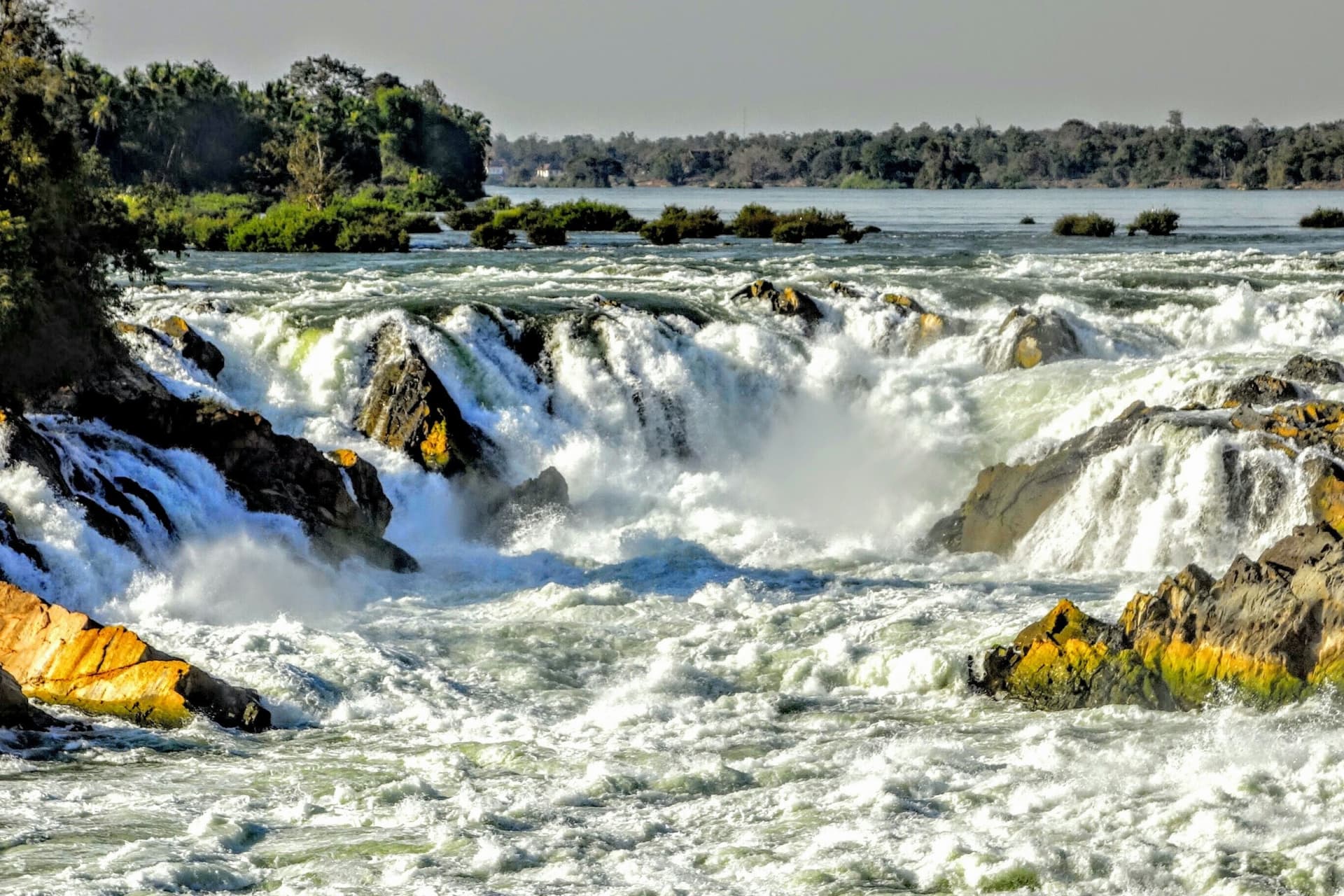
On the Mekong 130 km from Paksé, Khone Phapheng Falls form one of Southeast Asia's widest rapids systems, at the heart of the 4000 Islands.
Khone Phapheng Falls form one of Southeast Asia's most powerful rapids systems. Located on the Mekong at the far south of Laos, near the Cambodian border, they mark the end of the river's journey through Laos before it enters Cambodia. For local communities, they represent a natural barrier to wandering spirits inhabiting the region—a belief that adds symbolic depth to a site already spectacular in its sheer force.
Why visit Khone Phapheng Falls
The site stands out for three rare characteristics:
- Hydraulic scale: with an average flow of approximately 11,000 m³ per second, reaching up to 49,000 m³ during flood season, Khone Phapheng ranks among Asia's widest falls.
- Biodiversity: the waters are home to the giant catfish Tra Dau (Pangasiidae family), an endangered species reaching 3 metres and 300 kg, as well as, nearby, a residual population of Irrawaddy freshwater dolphins.
- Cultural context: the archipelago of 4000 Islands (Si Phan Don) surrounding the falls offers a way of life that is distinctly river-based and characteristically Laotian, little altered by mass tourism.
A hydraulic gateway steeped in history
In the 19th century, under French Indochina, colonists sought to establish continuous navigation between Saigon and southern Laos by ascending the Mekong. Khone Phapheng and its rapids presented an insurmountable obstacle for steamboats. To overcome this challenge, the French built an iron bridge and a railway line between the islands of Don Det and Don Khone, enabling cargo and passengers to be transferred from one navigable section to another. This line, one of the few ever constructed in Laos, is now defunct. Its remnants—rails, an abandoned locomotive, bridge piers—remain visible on both islands and represent a rare testament to colonial engineering in Indochina.
What to see and do
The main viewpoint
Positioned high above the site, it offers the finest perspective over the mass of water crashing against the rocky ledges. A small pavilion shelters visitors and facilitates photography. The roar is continuous and audible hundreds of metres away.
The riverside trail
Several pathways allow you to follow the rapids at different elevations. The going is easy, though the mist thrown up by the falls can make rocks slippery.
The welcome complex
Immediately adjacent to the site, a cluster of stalls groups together restaurants, cafés and local craft vendors. It's a useful stopping point between viewing the falls and heading back to the islands.
When to visit
The dry season, from November to March, offers the clearest view of the falls' relief: the rocky ledges are exposed and the rapids structure is clearly visible. During the rainy season (June to September), the Mekong flood submerges much of the feature and the flow becomes so massive that the landscape becomes harder to read—the spectacle remains impressive, but less distinct. Morning light is favourable and crowds are lighter.
Practical information
- Admission: paid entry for foreign visitors, reduced rate for residents (moderate, payable in kips at the entrance booth).
- Hours: daytime opening from morning until late afternoon.
- Swimming forbidden due to the power of the current.
- Duration of visit: allow 1 to 2 hours on site, longer if you combine with a trip around Don Khone.
- What to bring: water, hat, shoes with good grip.
How to get there
Access is from Paksé, approximately 130 km to the north. The road leads to Nakasang landing, from where you reach the Si Phan Don (4000 Islands) archipelago by longboat. The falls are connected to Don Khone island, which is easily explored by bicycle (rentals available on the island at a moderate daily rate). The old French bridge linking Don Det and Don Khone remains passable on foot or by bicycle.
Nearby
- Don Det and Don Khone: the two most visited inhabited islands of the archipelago, linked by the old colonial bridge. Railway remnants, riverside accommodation, river atmosphere.
- Irrawaddy dolphin observation: longboat excursions from Don Khone towards the reach where this endangered species' small transboundary population survives.
- Li Phi Falls (Somphamit): a second rapids system on Don Khone, more accessible but not as wide as Khone Phapheng.
- Paksé: the essential hub for exploring the 4000 Islands and the Bolovens Plateau.
Frequently asked questions
Frequently asked questions
Plan your journey
Khone Phapheng Falls fit naturally into an itinerary combining Paksé, the Bolovens Plateau and the 4000 Islands. To build a tailor-made trip including this region, explore our journeys in Laos.
Interested in this visit?
We can include it in your personalised itinerary.