The Greatest Festivals to Celebrate in Laos
There's nothing quite like discovering a country during its national festivals, mingling with the local population to share in these moments of national celebration and precious family gatherings.
There's nothing quite like discovering a country during its national festivals, mingling with the local population to share in these moments of national celebration and precious family gatherings. Your local travel agency presents the greatest festivals celebrated in Laos.
Festival of Rockets, "Boun Bang Fay" and "Boun Visakha Bouça"
The 15th day of the waxing moon of the 6th month in the Lao calendar (full moon of May) corresponds to Visakha Bouça, a triple anniversary commemorating the birth of the Buddha, the day of his enlightenment, and the day of his death. But woven into this Buddhist religious festival are ancient ancestral customs which, on the eve of the rainy season, appeal to the sky gods (phagna thèn) to obtain abundant rains, happiness, and prosperity. It is also, in the background, a celebration of fertility.
In the Vientiane plains, this ceremony does not take place on a fixed date and must be celebrated after that of the capital, according to a calendar established by the villagers. Some villages band together, each crafting their own rocket—a long bamboo shaft whose body is composed of an assembly of multicolored papers. The role of monks emerges in the rocket-making phase, as the rocket represents the village and thus the wat. The monks are the pyrotechnicians of the festival.
The ceremony lasts two days and is twofold. Before any major religious festival, chosen by many young people to be ordained as monks in order to acquire merit and show their gratitude to their parents. It is then the rockets that set fire to the Buddha's funeral pyre. A secular festival, a highly colorful and noisy procession, more akin to a carnival than a religious procession, is organized. It is composed of men, some of whom dress as women. The makeup is outrageous, the songs are risqué, and the whole affair is generously lubricated. In rural areas, the festival honors the spirits of the place (Phi); the master of ceremonies, (Chao Cham), and the medium women, (Nang Thiem), precede the procession to the spirit house (Ho Phi).
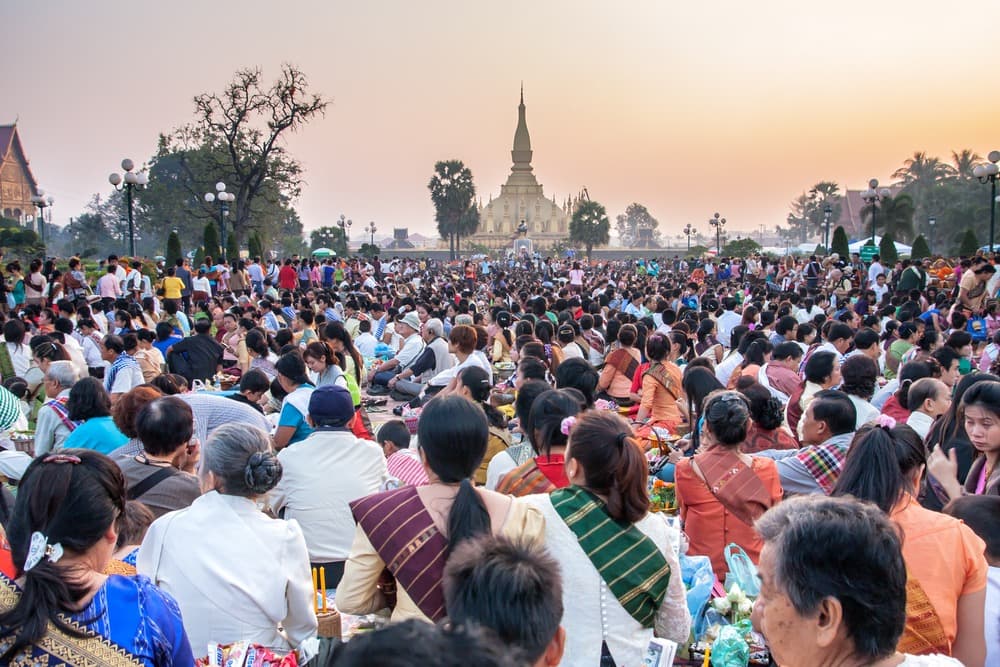
The End of Buddhist Lent "Ok Phansa" "At the full moon of the eleventh month, the Lao hold a ceremony, the Boun Ok Phansa, festival marking the end of lent (Phansa, derived from the same Pali word meaning rain), or Boun Pavârana. This is therefore a festival celebrated at the end of the rainy season. On the day lent ends, before parting, the monks organize an assembly during which they recite the pavârana formula, according to which each of them asks the others what they have done that was reprehensible during the three months spent together, and begs their pardon for his faults. With reconciliation thus achieved, they separate to return each to his pagoda. On the occasion of the end of lent, the faithful offer, among other things, clothing to the monks so that they may have a change of garments. To this are added the illumination of pagodas and houses, processions, the launching of illuminated rafts on the river, boat races…"
Water Festivals and Boat Races
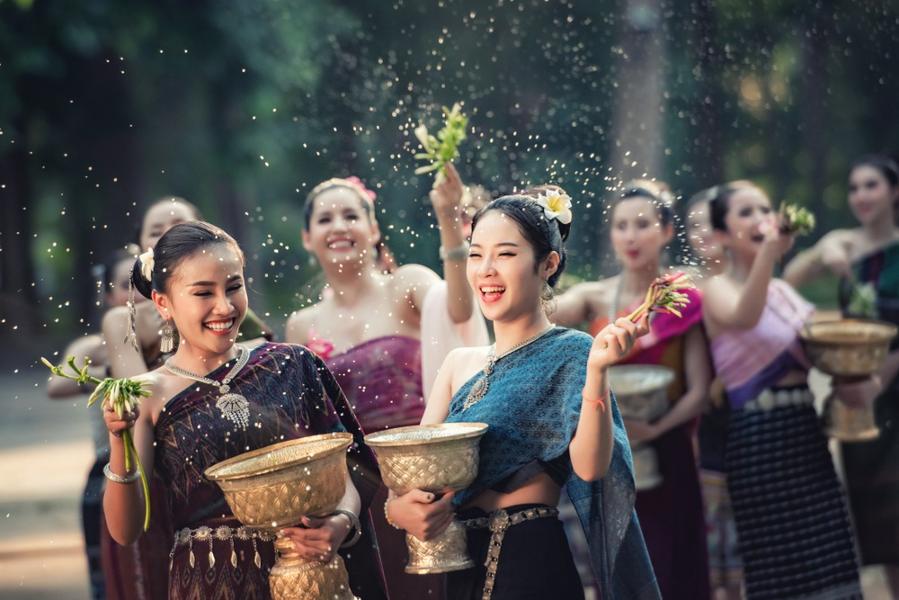
At the full moon of the 11th month, the Boun Ok Phansa (or Ok Vatsa) is celebrated. It is the "exit from the rains," and thus from the lent that will have lasted three months. To Buddhist religious ceremonies are grafted secular festivals including the "water festival" which is followed by the "boat race," organized in honor of the Naga and water spirits so that they may bring health, happiness, and prosperity. On the eve of the race, as night falls, small bamboo or banana tree trunk rafts, illuminated with candles, are launched on the river. All villages residing on the banks of the river or its tributaries participate in the race. The best boat will bring prestige to the village that built it, even though nowadays the boats are sponsored by commercial enterprises.
In Luang Prabang, the race takes place two months earlier, at the time of Ho Khao Phadap Dinh, mid-lent and festival of the dead. "During the ninth month of the Buddhist calendar, at the time of the 'Ho Khao Padap Dinh' festival, boat races are held on the Nam Khan, two months before those in Vientiane which take place in September-October at the exit from Buddhist lent. These boats, hollowed from a large tree trunk, are stored under a shelter in most pagodas. Some very beautiful ones can be seen at Vat Mai, at Vat Sène, and at the Royal Palace. They are caulked and repainted each year with stenciled motifs. At the time of the races, they are decorated with bouquets and propitiatory garlands, manned by about fifty rowers and a steersman. The races pit the city's neighborhoods against each other two by two, through successive heats that passionate crowds follow from the riverbanks."
The Beginning of Buddhist Lent "Khao Phansa"
Beginning at the full moon of the eighth month (July), Buddhist lent in Laos, which ends at the full moon of the eleventh month (October), marks the period of abstinence for monks. Before the beginning of lent, the faithful gather by neighborhood to prepare candles. A competition is then organized in a designated location, where the name of the pagoda to which the finest candles will be offered is drawn by lot. Then a procession takes place through the city streets to reach the temples. But in the provinces, in villages, the faithful offer candles to the monks without having previously conducted any special ceremony.
During the first two days, the religious confess to their hierarchical superiors. Then, throughout the duration of lent, they strictly observe the rules prescribed by religion, which notably forbids them from spending the night outside the pagodas."
The End of Buddhist Lent "Ok Phansa"
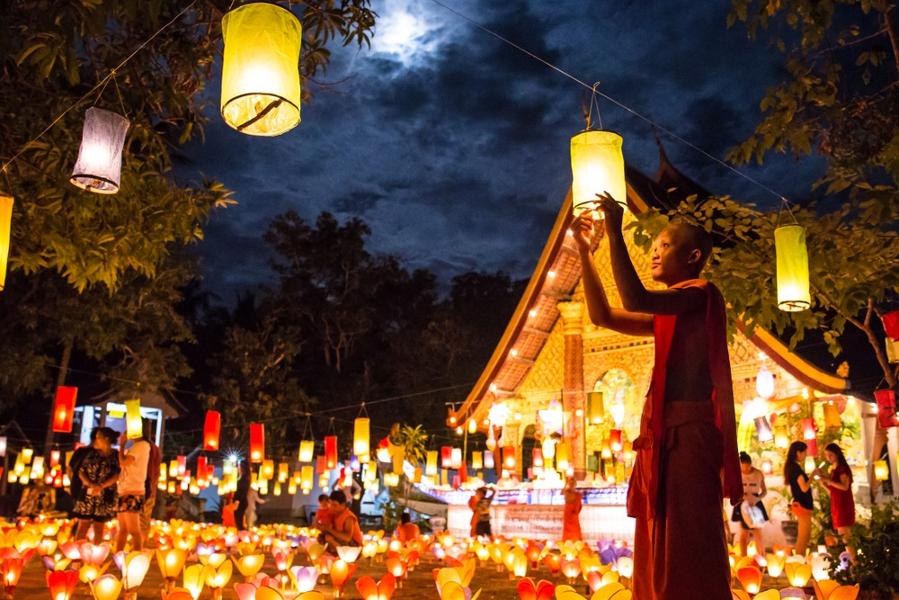
At the full moon of the eleventh month, the Lao hold a ceremony, the Boun Ok Phansa, festival marking the end of lent (Phansa, derived from the same Pali word meaning rain), or Boun Pavârana.
This is therefore a festival celebrated at the end of the rainy season. On the day lent ends, before parting, the monks organize an assembly during which they recite the pavârana formula, according to which each of them asks the others what they have done that was reprehensible during the three months spent together, and begs their pardon for his faults. With reconciliation thus achieved, they separate to return each to his pagoda.
On the occasion of the end of lent, the faithful offer, among other things, clothing to the monks so that they may have a change of garments. To this are added the illumination of pagodas and houses, processions, the launching of illuminated rafts on the river, boat races…"
Frequently asked questions
Laos's major festivals follow the Buddhist lunar calendar. Boun Bang Fay (rocket festival) takes place at the full moon in May, Khao Phansa (beginning of lent) in July, and Boun Ok Phansa (end of lent) in October. The October-November period is particularly festive with boat races on the Mekong and Nam Khan rivers.
Boun Ok Phansa is the festival marking the end of Buddhist lent, celebrated at the full moon of the eleventh lunar month (October). Monks gather to recite the pavârana, a formula of reconciliation. The faithful illuminate pagodas, launch candle-lit rafts on the river, and attend boat races. It is one of the most spectacular festivals to witness in Laos.
Yes, the boat races are open to the public, including foreign tourists. In Vientiane, they take place in September-October on the Mekong. In Luang Prabang, they occur two months earlier, in July-August on the Nam Khan. It is advisable to arrive early to find a good spot on the riverbanks and to respect local traditions.
Boun Bang Fay is both a religious and popular festival celebrated at the full moon in May. Villages craft large bamboo rockets decorated with multicolored papers, launched into the air to call for rain and prosperity. The festival blends Buddhist ceremonies with animist traditions, featuring colorful and noisy processions that resemble a carnival.
Luang Prabang is particularly lively during Ho Khao Phadap Dinh (mid-lent and festival of the dead) with its boat races on the Nam Khan. The city is also beautiful during Boun Pi Mai (Lao New Year in April) with its processions and ritual water purification ceremonies. These periods offer unique cultural immersion but attract more visitors—be sure to book in advance.