History of the Laotian Flag
The flag of the Lao People's Democratic Republic as we know it today has evolved over more than a century since the establishment of the French Protectorate over Laotian territory.
The flag of the Lao People's Democratic Republic as we know it today has evolved over more than a century since the establishment of the French Protectorate over Laotian territory. At that time, it was the flag of the kingdom of Luang Prabang that was deemed representative for this territory, though punctuated with a French symbol.
By grouping the kingdoms of Luang Prabang, Champassak on the Cambodian border, and part of Siam, the French formed in 1893 the territory that most closely resembles present-day Laos. The French Protectorate. The key distinction from a direct colony is that the invested territory was not placed under complete direct control by the metropolitan power. It retained a certain autonomy, and local identity remained paramount from this perspective. The French, having developed particular relations with the king of Luang Prabang, decided to use the flag of this region for this new territory.
The Luang Prabang Flag Predominant
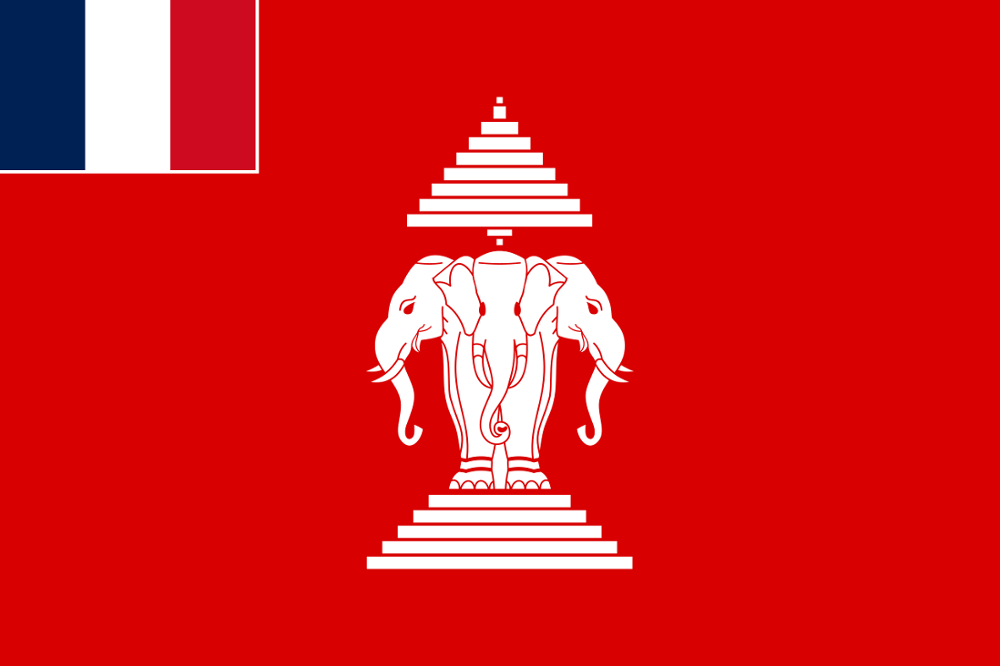
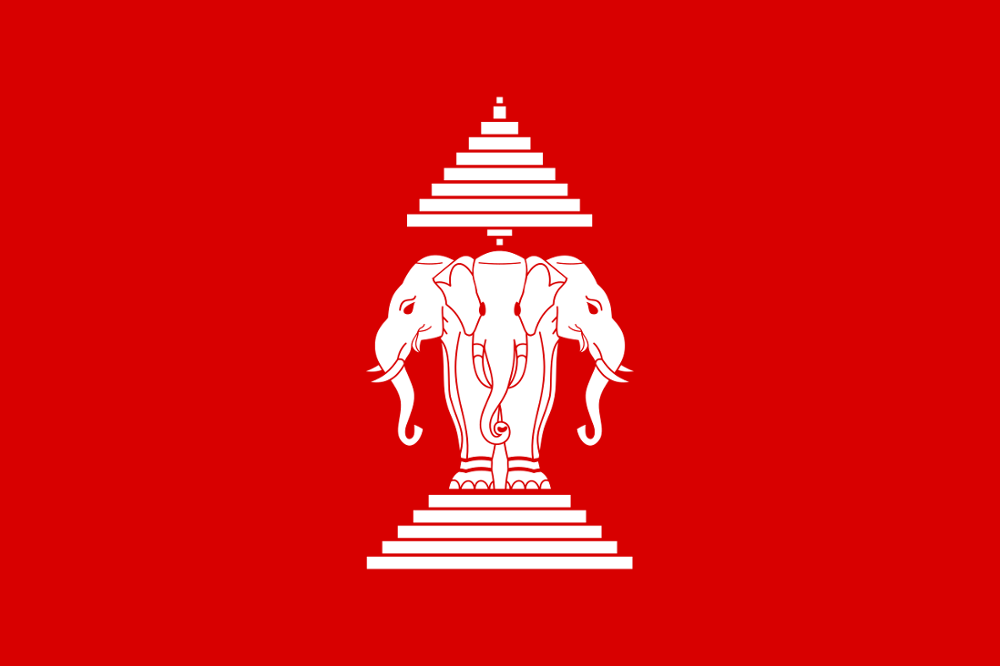
Against a red background, in the center and in white, was depicted the mythical elephant, king of beasts in Hinduism, Airavata. Represented with its three heads standing on a pedestal and topped by a white parasol. Mount of the god Indra, it is one of the beings born from one of the most important cosmological myths in Hinduism: the churning of the ocean of milk, like the Apsaras, these celestial nymphs of great beauty much represented in Cambodia, or Surabhi the cow of abundance, perpetual source of milk and butter. This Luang Prabang flag was simply modified by the addition of the French flag in the upper left corner.
With independence in 1954, the unified Kingdom of Laos decided to keep this same flag, naturally removing the French addition.
Today's Flag
The Kingdom of Laos became the Lao People's Democratic Republic on December 2, 1975 following the abdication of King Savang Vatthana and Queen Khamphoui. The flag was modified immediately to become the one we know today. Already used by the Lao Issara independence movement, fierce opponents of the Protectorate, between 1945 and 1946, the flag was later adopted by the communists of the Pathet Lao who overthrew the government and took power in 1975.
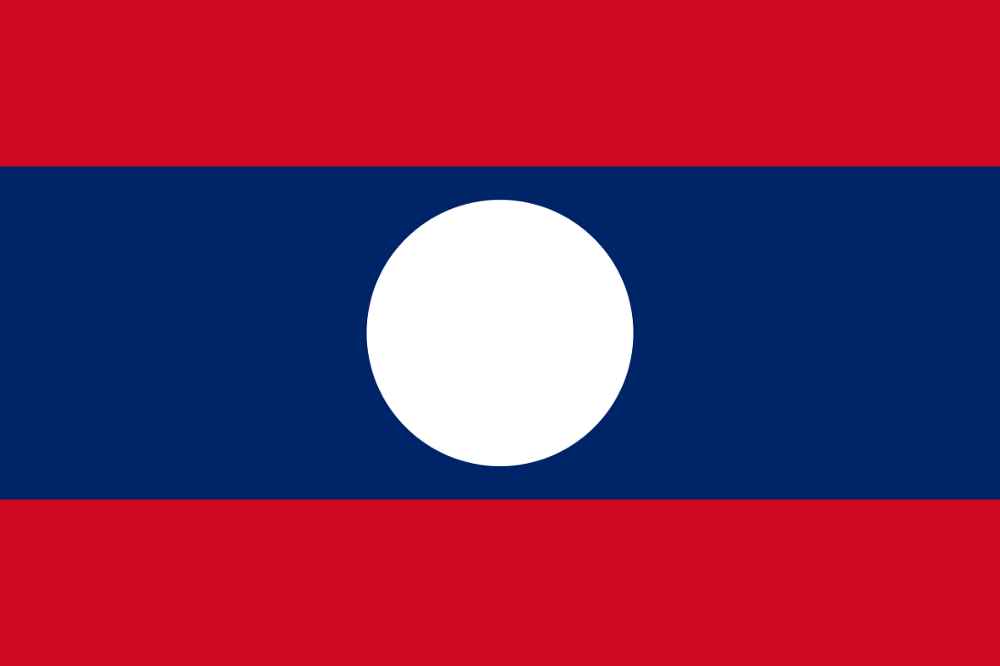
It features three horizontal stripes, two red ones at the top and bottom symbolizing, as in many other countries, the blood shed for the nation. The central blue stripe represents the legendary Mekong River, which in Laos comprises nearly 50% of the border with Thailand. The white circle at the center amplifies the significance of the Mekong, representing the moon glimmering above the river, a symbol of peace and national grandeur.
Frequently asked questions
The flag of Laos is composed of three horizontal stripes: two red stripes (top and bottom) symbolizing the blood shed for the nation, and a central blue stripe representing the Mekong, the legendary river that forms nearly 50% of the border with Thailand. The white circle in the center evokes the moon shining above the river, a symbol of peace and national grandeur.
Before 1975, Laos used a red flag adorned with a three-headed white elephant, Airavata, standing on a pedestal beneath a white parasol. This symbol originated from the flag of the kingdom of Luang Prabang, adopted under the French Protectorate (1893) and then retained following independence in 1954.
On December 2, 1975, King Savang Vatthana abdicated and Laos became the Lao People's Democratic Republic under the direction of the communist Pathet Lao movement. The new regime adopted the tricolor flag (red, blue, white) that had already been used by the Lao Issara independence movement between 1945 and 1946, replacing the royal elephant flag.
The three-headed elephant depicted on the old flag is Airavata, a mythical creature in Hinduism and the mount of god Indra. Born from the churning of the ocean of milk, one of the foundational cosmological narratives of Hinduism, it symbolizes royal and divine power. Laos, strongly influenced by Hindu and Buddhist culture, had adopted this animal as a national emblem.
The French Protectorate over Laos was established in 1893. The French then grouped the kingdoms of Luang Prabang, Champassak, and part of Siam to form a territory corresponding roughly to present-day Laos. Unlike a direct colony, the Protectorate allowed a degree of local autonomy, which explains the retention of the Luang Prabang flag as the official symbol.