Don Khone Island
Don Khone Island
Don Khone, in the Si Phan Don archipelago, combines Li Phi Falls, Irrawaddy dolphin watching, and colonial railway heritage. A car-free island to explore by bicycle, between rice paddies and the Mekong.
Don Khone is one of the largest islands in the Si Phan Don archipelago, in southern Laos, where the Mekong fragments into hundreds of channels. Without cars or motorcycles, the island is explored on foot or by bicycle along dirt tracks bordered by rice paddies and wooden houses. It concentrates two major natural sites — Li Phi Falls and the last habitat of the Irrawaddy dolphin — in an area that has remained largely removed from mass tourism.
Quick facts at a glance
- Access: boat from Ban Nakasang (east bank); short crossing, frequent daily departures.
- Entry: island access fee payable (combined ticket including Li Phi Falls).
- Island transport: bicycle rental available from guesthouses; no motorized vehicles permitted.
- Dress code: no strict dress code, but covered clothing recommended in villages.
- Recommended duration: minimum full day; one night on the island to enjoy the peaceful morning atmosphere.
- Accessibility: limited — unpaved paths, stairs at the falls.
What to see
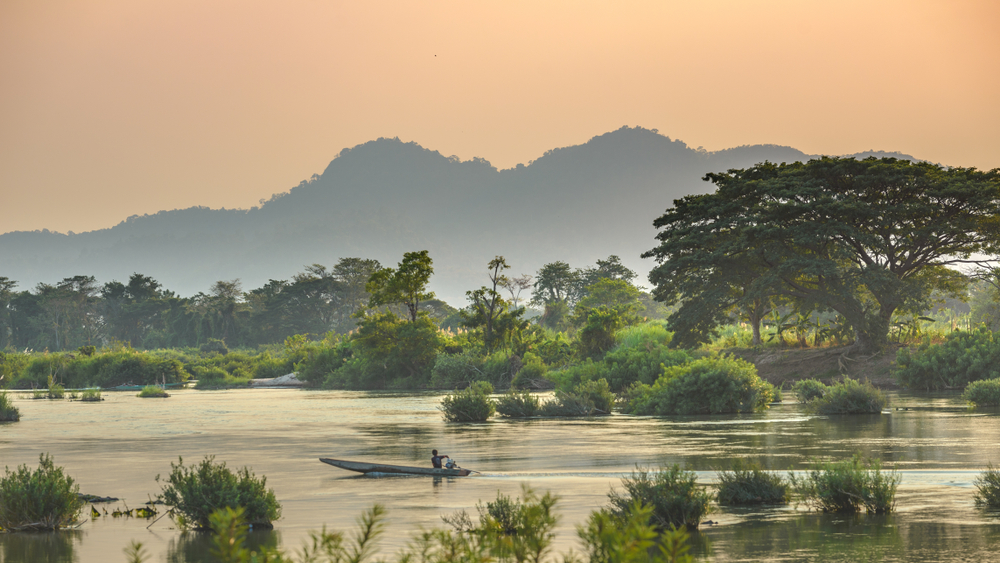
The island offers an alluvial plain landscape: low-terraced rice paddies, coconut palms, vegetable gardens, and fishing villages with houses on stilts. An old French colonial railway bridge spans an arm of the Mekong toward the neighboring island of Don Det. The riverbanks reveal, at dawn, fishing pirogues and, sometimes, the silhouettes of Irrawaddy dolphins.
History and context
In the late 19th century, colonial France sought to connect the Mekong to the Indochinese railway network to bypass impassable rapids. A narrow-gauge line was built between Don Khone and Don Det — Laos's first railway. The rails have vanished, but the metal bridges and a rusted locomotive still testify to this ambitious project, abandoned after independence.
Highlights of your visit
Li Phi Falls (Somphamit)
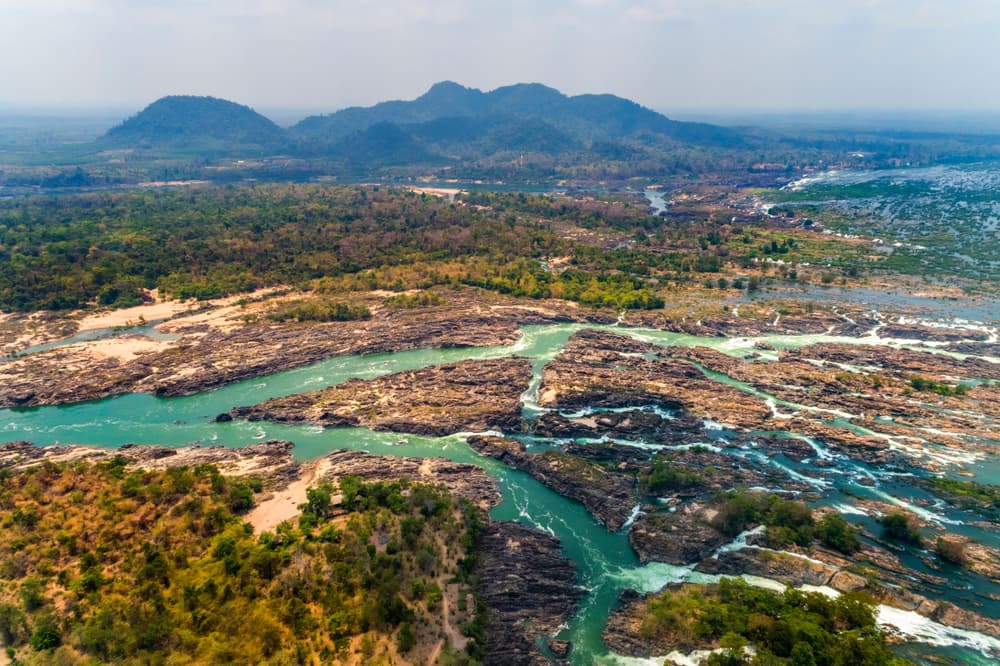
These powerful rapids, at the southwestern tip of the island, are not a single waterfall but a tangle of cascades and basalt rocks. The flow is spectacular during the rainy season (June–October); in the dry season, the rock formations are more visible. A trail runs along the riverbank to the viewpoints closest to the rapids.
Irrawaddy dolphin watching
A residual population of Irrawaddy dolphins (Orcaella brevirostris) survives in the Mekong channel between Don Khone and the Cambodian border. Boat trips depart early in the morning from Ban Hang Khone village, in the south of the island. Sightings are never guaranteed; the species is critically endangered.
Colonial bridge and locomotive
The French metal bridge, built around 1893, connects Don Khone to Don Det. At its Don Khone end, a rusted steam locomotive is displayed in the open air — a concrete vestige of the narrow-gauge line. Crossing the bridge offers an open view of the Mekong in both directions.
Ban Khone Tai village
This fishing village in the south of the island preserves the wooden architecture typical of the Laotian delta. Locals practice fish-trap fishing in the rapids. Village life unfolds at a leisurely pace, particularly visible in the late afternoon.
Photography tips
Li Phi Falls are best photographed late morning, when light strikes the rapids head-on from the designated viewpoints. For dolphins, a long focal length is essential — the animals remain at a distance. The colonial bridge lends itself to backlighting at sunrise from Don Det's bank. Avoid flash in nighttime fishing areas.
Location and access
Don Khone is located in Champasak Province, approximately 10 km south of the town of Muang Khong (Don Khong Island). The main departure point is Ban Nakasang, accessible from Pakse by bus (approximately 4 hours) or minivan. Direct shuttles to Ban Nakasang depart Pakse in the morning. Don Khone is connected to Don Det Island by the colonial bridge — the two islands can be visited together by bicycle. Accessibility is challenging due to unpaved paths.
Nearby attractions
- Don Det Island — direct neighbor connected by the colonial bridge, more lively, with more accommodations and riverfront restaurants.
- Don Khong Island — the largest island in Si Phan Don, to the north, with Buddhist temples and a provincial town atmosphere.
- Pakse — capital of Champasak Province, logistics hub for Si Phan Don and the Bolaven Plateau.
- Wat Phu — Khmer temple listed as a Unesco World Heritage site, approximately 45 km north of Pakse.
Frequently asked questions
The dry season (November–April) offers passable roads and clear skies. Li Phi Falls are more impressive in water volume between July and October, but paths may be muddy.
No. Sightings depend on animal behavior and season. Early morning boat trips increase chances, but no guarantee is possible for such a rare species.
A day is sufficient for the falls and colonial bridge. Staying one night allows for an early dolphin expedition at dawn and lets you enjoy the island's peace after day-trippers depart.
Yes, the colonial bridge connects them directly. By bicycle, it's easy to move between islands in half a day and combine both in a full day.
There is no ATM on Don Khone. Bring sufficient Laotian kip before crossing from Ban Nakasang.
Yes, photography is free at the designated viewpoints. No particular restrictions are noted for visitors.
Want to discover this destination?
Our local advisors design your tailor-made trip.