The Living Land Company
A participatory rice farm on the banks of the Mekong, Living Land Company offers visitors the chance to experience every stage of sticky rice cultivation—the foundation of Lao cuisine—working alongside local farmers.
A short distance from Luang Prabang, on the banks of the Mekong, The Living Land Company is an educational rice farm that invites visitors to participate in the full cycle of rice cultivation. Far from a mere demonstration, the experience is physical and immersive: you work the mud with your hands, labor alongside local farmers, and understand why rice shapes all of Lao life.
Practical Information at a Glance
- Type: participatory educational farm, English-language guided tours
- Attire: clothes you don't mind getting dirty, barefoot in the paddies — bring a change of clothes
- Recommended duration: approximately 2 to 3 hours for the full program
- Access: by tuk-tuk or bicycle from central Luang Prabang; the farm is located in the village of Ban Phan Luang, on the opposite bank of the Mekong
What You'll See
Stretches of sticky rice paddies unfold in gentle terraces down to the river. Depending on the season, the fields are being ploughed, replanted, growing, or harvested—each stage offers a different activity. Water buffalo sometimes work alongside participants. The rural setting, free of heavy tourist infrastructure, presents an authentic picture of Lao subsistence agriculture.
History and Context
The Living Land Company was founded to preserve traditional agricultural knowledge while creating direct income for local farming families. The model embodies responsible agritourism: a portion of revenue returns to participating farmers. The sticky rice (khao niao) cultivated here is the daily dietary staple in Laos—understanding its cultivation means understanding Lao culture itself.
Highlights of the Visit
The Complete Rice Cycle in One Morning
The program guides participants through each stage: hand ploughing or working with buffalo, transplanting seedlings in neat rows through the mud, threshing the grain, winnowing and hulling. Each gesture is explained by a local farmer, with translation provided by your guide.
The Final Tasting
The visit concludes with a tasting of sticky rice steamed in a woven bamboo basket (kratip), accompanied by local condiments. Simple and memorable—especially after having labored to produce it.
Interaction with the Families
The farmers are not extras: they are the owners of the plots. Exchange, even without a shared language, is direct and genuine. It's one of the rare contexts in Luang Prabang where contact with rural people is unscripted.
Photography Tips
Morning light is ideal: the low angle creates golden reflections on the water between plants. Protect your equipment from moisture and mud—a smartphone in a waterproof pouch usually suffices. Always ask permission from farmers before photographing them closely.
Location and Access
The farm is located in the village of Ban Phan Luang, accessible from Luang Prabang by bridge or boat depending on the Mekong's water level. By bicycle, the journey from the city center is pleasant and flat. By tuk-tuk, it's a short trip. The farm is near the Mekong and can be combined with visits to craft villages on the south bank.
Nearby Attractions
- Village of Ban Xang Khong — village of weavers and traditional sa paper makers, nearby on the Mekong riverbank.
- Kuang Si Waterfalls — emblematic turquoise cascades of the region, about thirty kilometers south of Luang Prabang.
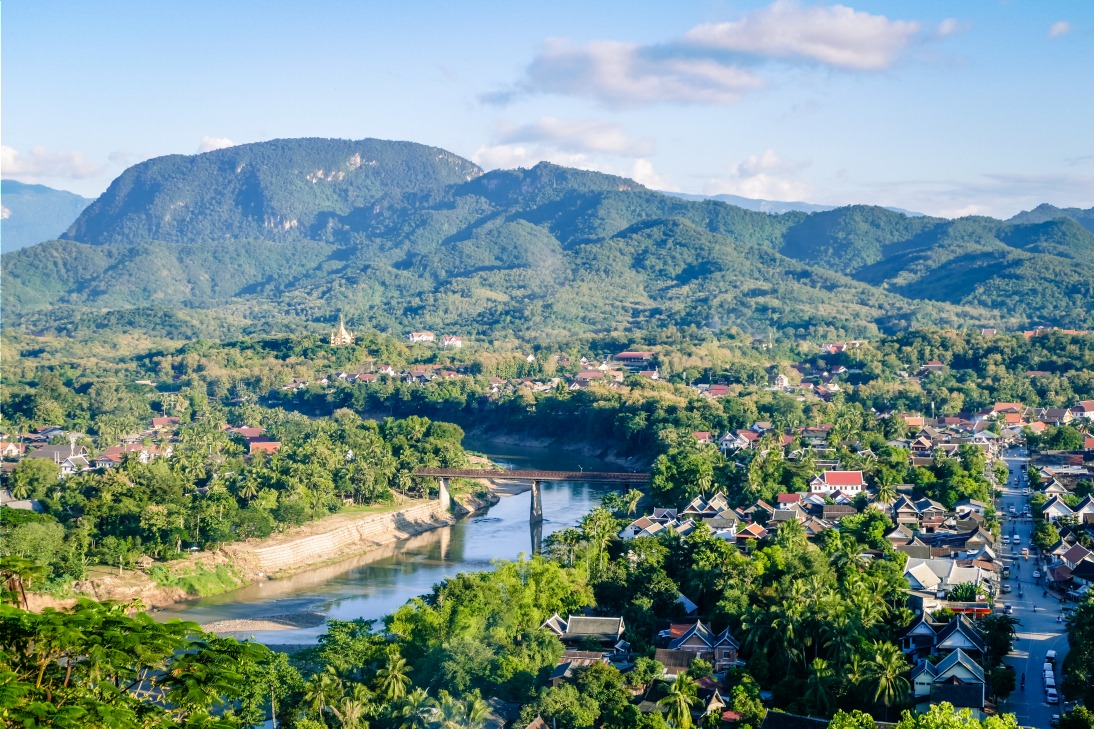
- Phou Si Hill — central hill of Luang Prabang with temple and panoramic views over the city and Mekong.
- Luang Prabang Morning Market — local market where agricultural products from the region, including sticky rice, are sold each morning.
Frequently asked questions
Advance booking is recommended, especially during peak season (November to February). Contact the farm directly or work through a local agency to secure your place.
Clothes you don't mind getting dirty and a change of clothing. You'll work barefoot in the mud of the paddies — avoid delicate or light-colored garments.
Yes, children typically love the physical and playful aspect—wading through mud alongside water buffalo is a memorable experience for them.
Each season offers a different stage in the rice cycle. The rainy season (June-October) corresponds to transplanting and growing—the fields are green and highly photogenic. The dry season (November-February) is more comfortable climate-wise.
Yes. The program typically concludes mid-morning, leaving time to visit neighboring craft villages or return to central Luang Prabang for the afternoon.
Nearby

Interested in this visit?
We can include it in your personalised itinerary.