Plain of Jars
Plain of Jars
A unique megalithic site in Southeast Asia, the Plain of Jars brings together hundreds of stone urns dating back 2,000 years, UNESCO-listed since 2019.
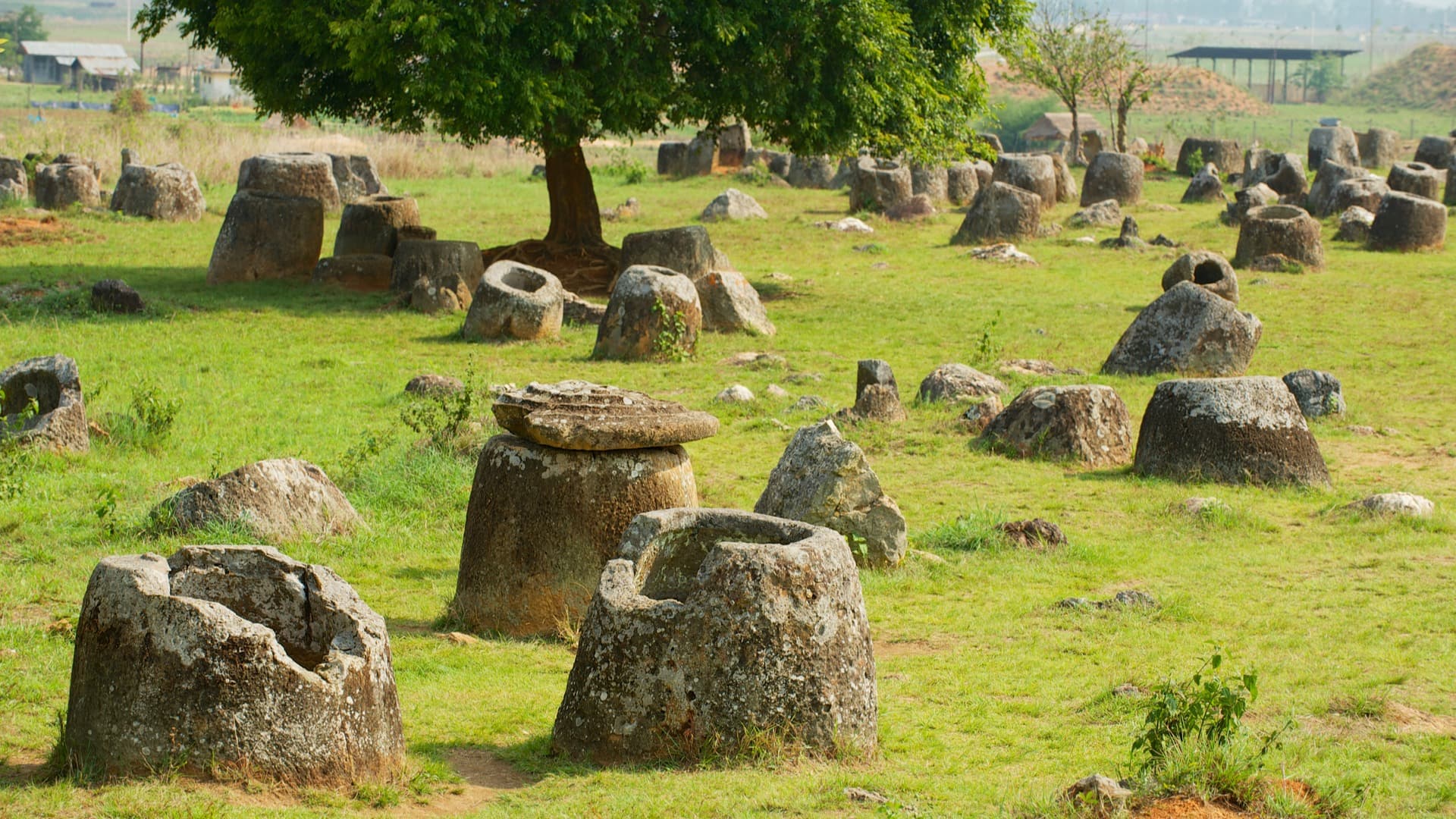
On a high-altitude plateau in Xiangkhouang Province, in northeastern Laos, hundreds of stone jars carved some 2,000 years ago rest in open fields. This megalithic site, known as the Plain of Jars, is one of Southeast Asia's most enigmatic wonders. It has been inscribed on the UNESCO World Heritage List since July 6, 2019, and can be visited from the town of Phonsavan.
Why visit the Plain of Jars
The site captivates through its uniqueness: over 90 jar sites have been documented in the province, containing more than 2,100 stone megaliths in total. Carved from limestone, sandstone, or granite, these jars weigh up to 7 tons and reach 3 meters in height. Their shapes vary—with straight mouths, squared rims, and knots—and some still bear bas-relief carvings. No equivalent concentration exists anywhere else on mainland Asia.
Beyond the archaeology, a visit offers access to a rural region rarely touched by mass tourism, featuring rolling hills, Hmong and Lao villages, and a cooler climate than the Mekong plains.
History and archaeological hypotheses
The jars were first studied by French archaeologist Madeleine Colani, who documented them in 1930. Excavations were long interrupted, notably due to regional conflicts, and only resumed in earnest in 1994. Current dating places their creation around 2,000 years ago.
Three interpretations coexist to explain their function:
- A local legend recounts that the jars were created to store fermented rice wine for a banquet honoring a mythical king.
- A utilitarian theory suggests they served to collect rainwater during the monsoon season, for caravans of travelers crossing the plateau.
- The archaeological hypothesis now favored, supported by the discovery of skeletal remains and funerary objects, interprets them as burial urns linked to secondary cremation practices.
The site's recent history is also marked by the Vietnam War: American bombing campaigns over Laos damaged many jars and left the terrain saturated with unexploded ordnance (UXO). This context continues to complicate excavations and imposes strict circulation rules for visitors.
What to see: sites open to the public
Of all documented sites, seven are currently open to visitors, cleared of ordnance, and clearly marked. Each has its own character.
- Site 1: the closest to Phonsavan and the most frequented. It is the most accessible but also the most developed.
- Sites 2, 3, and 16: located near the former capital of Xieng Khouang, they connect well over a half-day. Site 3 is reached by an easy walk through rice paddies and bamboo groves.
- Site 23: close to the hot springs of Muang Kham, interesting to combine with a thermal sojourn.
- Site 25: in Phou Kout district, far less crowded.
- Site 52: the largest, with 392 recorded jars, but rarely visited due to distance and requiring hiking.
At all sites, white and red markers indicate cleared areas: it is imperative to stay on marked trails.
Practical information
Allow approximately 2 hours per site for a comfortable visit, or a full day to cover sites 1, 2, and 3. The logistical base is Phonsavan, which concentrates accommodation, local agencies, and motorbike rentals. A guide is recommended for remote sites (23, 25, 52), both for navigation and safety related to UXO.
Before or after your visit, Phonsavan's UXO Information Center offers useful insights into the plateau's recent history and ongoing demining efforts.
When to visit
The best period to explore the Plain of Jars extends from November to February, during the dry season. Temperatures remain cool at altitude, especially in the morning, and tracks are passable. From June to September, the monsoon makes certain routes difficult and visibility poor for photography. March-April is dry but marked by agricultural burning that obscures the air.
How to get there
Phonsavan is connected by road to major towns across the country. Journey times vary depending on road conditions and season:
- From Vientiane: overnight or daytime buses, expect around 10 to 12 hours on a winding route.
- From Vang Vieng: 7 to 8 hours by bus.
- From Luang Prabang: approximately 8 hours via routes 13 and 7.
For greater comfort, it is possible to charter a private minivan from Vientiane or Luang Prabang. A small airport also serves Phonsavan from Vientiane, considerably reducing travel time.
Things to combine in the region
The Plain of Jars fits naturally into a northern Laos itinerary. From Phonsavan, many travelers then head to the Nam Ou River or Luang Prabang, where you can visit the Pha Tad Ke Botanical Garden and the TAEC Ethnology Center. Further south, the Blue Lagoon in Vang Vieng and Mekong Eden Farm complete the circuit.
Frequently asked questions
Frequently asked questions
Prepare your trip
The Plain of Jars lends itself to a 2 to 3-day stop within a northern Laos circuit combining Vientiane, Vang Vieng, Phonsavan, and Luang Prabang. To build a tailor-made itinerary incorporating this archaeological site, consult our Laos voyages.
Interested in this visit?
We can include it in your personalised itinerary.