Hintang Archaeological Park
Hintang Archaeological Park
Located 35 km from Sam Neua in Houaphan Province, Hintang Archaeological Park features roughly 1,500 slate menhirs scattered across 72 jungle sites along a 12 km ridge.
At the far eastern edge of northern Laos, in Houaphan Province, Hintang Archaeological Park brings together roughly 1,500 menhirs carved from slate, spread across 72 sites deep within the jungle. This vast funerary complex, far less celebrated than the Plain of Jars, is explored on foot along a forested ridge approximately 35 km from Sam Neua.
Why Visit Hintang
Hintang remains one of Southeast Asia's most understated archaeological sites. Three elements make it worth the journey:
- A field of standing stones stretching 12 km along a ridge, with some slabs reaching 3.4 meters in height.
- A prehistoric funerary site considered by some researchers to predate the Plain of Jars, though precise dating remains debated.
- An independently explored site, without barriers or tourist ticketing, set in a mid-mountain forest landscape.
The absence of heavy infrastructure does impose a minimum of logistics: a long road from Luang Prabang or Phonsavan, followed by a walking approach.
Site History
In 1931, archaeologist Madeleine Colani, renowned for her work on the Plain of Jars, led the first study of Hintang's menhirs. Discoveries were modest: unrefined ceramic burial urns, stone and bronze objects. These artifacts are now displayed at the National Museum of Laos in Vientiane.
Since Colani's expedition, no further archaeological excavations have been undertaken on the site. The exact function of these standing stone alignments and the underground chambers they surmount remains largely to be documented. Researchers do agree, however, on the funerary dimension of the complex as a whole.
What You'll See
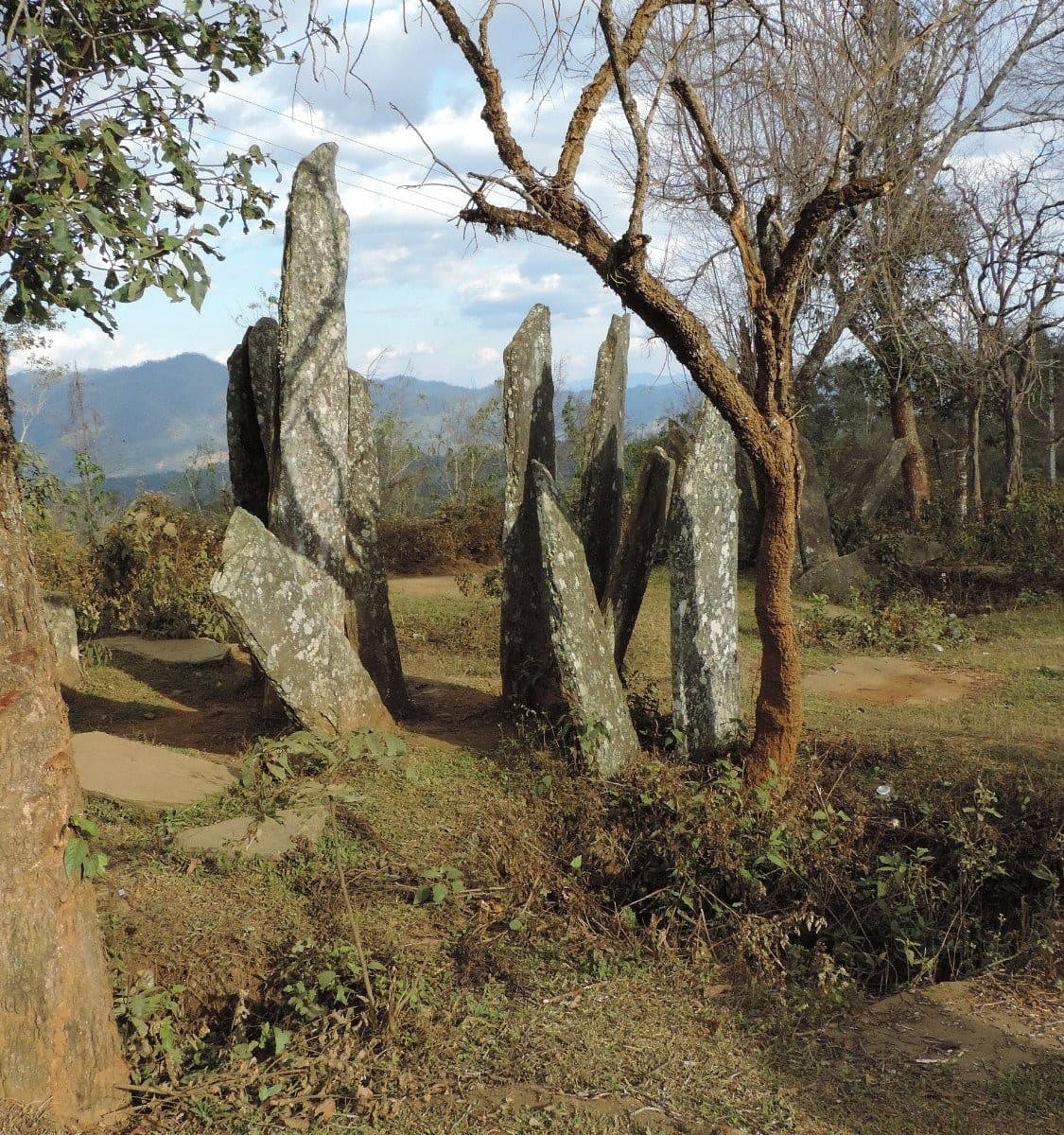
The park encompasses 72 identified sites within the jungle, totaling roughly 1,500 menhirs. These are upright stones shaped as pillars, carved from local slate. They extend along a ridge for 12 km, making exploration progressive: visitors typically explore the most accessible groups from the main entry point.
The Menhirs
The slate slabs vary in height, with some exceeding 3.4 meters. They are planted in tight clusters, sometimes aligned, sometimes scattered across a clearing. Access is unrestricted: you can move freely between the stones and approach them closely.
Stone Discs and Underground Chambers
Large stone discs placed at ground level seal the entrances to underground chambers. These cavities, considered burial chambers, are not accessible to visitors. The discs themselves remain visible and represent one of the site's distinctive features, with no direct equivalent at the Plain of Jars.
Reading the Site
Information panels in English are stationed on-site and provide essential interpretive details. No guide is mandatory, but a local companion from Sam Neua helps locate the most significant clusters.
How to Get There
The site lies in Houaphan Province, approximately 35 km from Sam Neua. The standard itinerary combines long-distance bus travel with local transport:
- Bus from Luang Prabang or Phonsavan to Sam Neua (long journey, plan a full day).
- From Sam Neua, road access to Ban Phao village, the marked departure point.
- From Ban Phao, roughly 6 km of walking to reach the main menhir sector; alternatively, a vehicle can be hired to reduce the walking portion.
No regular service reaches the park directly: you must combine public transport with walking, or arrange transport from Sam Neua.
Practical Information
- Access: free, with no ticket or fixed opening hours.
- Visit duration: allow 2 to 4 hours on site depending on how many clusters you explore, excluding travel time.
- Level: walking approach through forest terrain; closed-toe shoes recommended.
- Equipment: water, sun protection, insect repellent, torch useful in the wet season.
- Accommodation: in Sam Neua, where guesthouses and small hotels are available.
When to Visit
Houaphan Province enjoys a mid-mountain climate, cooler than the Mekong plain. The dry season, from November to March, offers the most comfortable conditions: accessible trails, pleasant walking, clear visibility. The wet season, from June to September, complicates access and makes paths slippery. April and May are hot but still dry.
Nearby Attractions
- Xamneua Fresh Market: local textiles, silver jewelry, and crafts made from bomb remnants—direct testimony to the province's recent history.
- Sam Neua Independence Monument, a landmark in the town center.
- Vieng Xay Caves, the former Pathet Lao headquarters during the Indochina War, roughly an hour's drive away.
To extend your Laos itinerary, you may also explore our pages on the Nam Ou River or Phou Khao Khouay National Park.
Frequently Asked Questions
Frequently asked questions
The park is situated in Houaphan Province in northeastern Laos, approximately 35 km from Sam Neua, the provincial capital. Access is via Ban Phao village followed by a roughly 6 km walk.
The park encompasses roughly 1,500 menhirs distributed across 72 identified sites within the jungle, along a 12 km ridge. Some slate slabs reach 3.4 meters in height.
Several studies suggest Hintang's burials predate those at the Plain of Jars, but no excavations have taken place since Madeleine Colani's 1931 mission. Precise dating remains to be confirmed.
The site is neither fenced nor guarded, and English-language information panels are installed on-site. A local companion from Sam Neua remains helpful for transport logistics and identifying the main menhir clusters.
November to March, during the dry season, offers the most favorable conditions: accessible trails and comfortable walking. The wet season (June–September) complicates access and makes paths slippery.
Include Hintang in a Laos Journey
Hintang fits into a northern Laos circuit that can combine Luang Prabang, Phonsavan, the Plain of Jars, and Houaphan Province. To build a tailor-made itinerary incorporating this still-understated archaeological site, explore our Laos travel ideas.
Interested in this visit?
We can include it in your personalised itinerary.