Laos, Land of 24 New Natural Species
The WWF announced in its report published Wednesday, December 12, the discovery of 157 new animal and plant species in the Greater Mekong Region during 2017.
The international NGO WWF announced in its report published Wednesday, December 12, the discovery of 157 new animal and plant species in the Greater Mekong Region during 2017, comprising Laos, Cambodia, Thailand, Vietnam, and Myanmar. The land of a million elephants recorded 24 new animal and plant species.
The Greater Mekong Region, which flows through China, Myanmar, Laos, Thailand, Cambodia, and Vietnam, harbors a treasure trove of biodiversity. The fauna and flora include notably Asian elephants, tigers, leopards, several species of pangolins, ibises, freshwater dolphins, and more. The Mekong alone is home to three times more fish species than the Amazon River. A total of 2.6 million tonnes of fish are caught each year, representing 25% of global freshwater catches.
Each year, scientists participate in the description and classification of new species present in the Greater Mekong Region. Some are discovered after meticulous fieldwork, sometimes spanning months in the field, and years of laboratory authentication.
An Extraordinary Plant
The report confirms that scientists discovered 24 new animal and plant species in Laos. There are a total of 14 new fish species*, the nadenensis gecko—a lizard never before seen—and nine plant species**. Among them lies the thismia nigricoronata, or black-crowned thismia, an "extraordinary plant" according to Dr. Pankaj Kumar, one of the scientists who discovered it. Recognized as such after 5 years of in-depth studies, it develops on limestone rocks around Vang Vieng, a small town north of Vientiane.
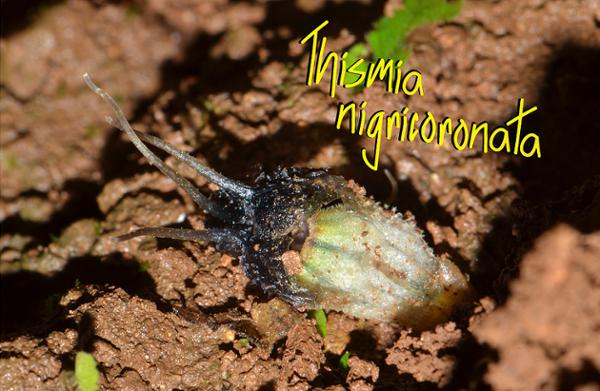
The thismia nigricoronata ©WWF
Sixteen new thismia species have been discovered in Asia and the Pacific over the last 15 years. "This particular discovery is very singular and interesting because it appears to be the only member of the genus that seems to have a green pigment," explains Dr. Kumar. The team of scientists has already assessed this species as critically endangered. But the researcher knows where to focus efforts next. "The least we can do is save the limestone mountains, which are not only a habitat for the black-crowned thismia, but also for many other interesting species that could be discovered in the future."
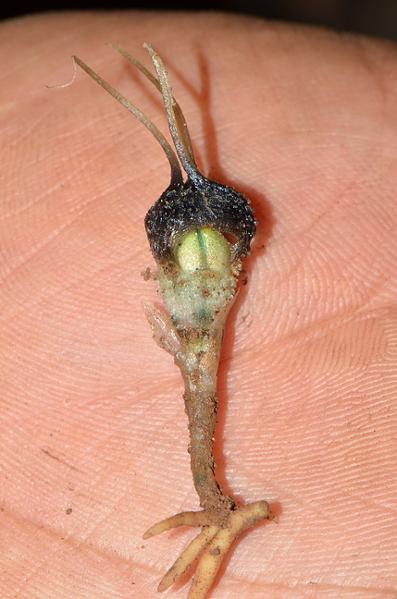
The black-crowned thismia in Dr. Kumar's palm ©WWF
* : carassius praecipuus / schistura epixenos / schistura crassa / schistura musa / schistura albisella / schistura systomos / glyptothorax porrectus / glyptothorax forabilis / schistura klydonion / schistura colossa / schistura thavonei / acantopsis rungthipae / acantopsis dinema / acantopsis ioa.
** : thismia nigricoronata / nervilia kasiensis / nervilia kasiensis / peliosanthes tatianae / tupistra orlovii / tupistra orlovii / peliosanthes hirsuta / strobilanthes namkadingensis / bulbophyllum jingdongense.
Frequently asked questions
In 2017, the WWF documented 24 new animal and plant species in Laos, including 14 fish species, 1 lizard (the nadenensis gecko), and 9 plant species, among which the remarkable thismia nigricoronata.
The thismia nigricoronata, or black-crowned thismia, is an extraordinary plant discovered on limestone rocks near Vang Vieng, north of Vientiane. Recognized after 5 years of studies, it is the only member of its genus to possess a green pigment. It is already classified as critically endangered.
The Greater Mekong Region, flowing through China, Myanmar, Laos, Thailand, Cambodia, and Vietnam, harbors exceptional ecosystems. The Mekong River alone contains three times more fish species than the Amazon, and the region is home to iconic animals such as Asian elephants, tigers, and freshwater dolphins.
According to the WWF report published in December 2018, 157 new animal and plant species were discovered in the Greater Mekong Region during 2017, distributed across Laos, Cambodia, Thailand, Vietnam, and Myanmar.
Laos offers numerous opportunities for nature enthusiasts. The surroundings of Vang Vieng, where the thismia nigricoronata was discovered, feature spectacular limestone formations. Other areas such as the Bolaven Plateau, the Nam Et-Phou Louey Reserve, or the forests of the south allow visitors to observe remarkable fauna and flora.