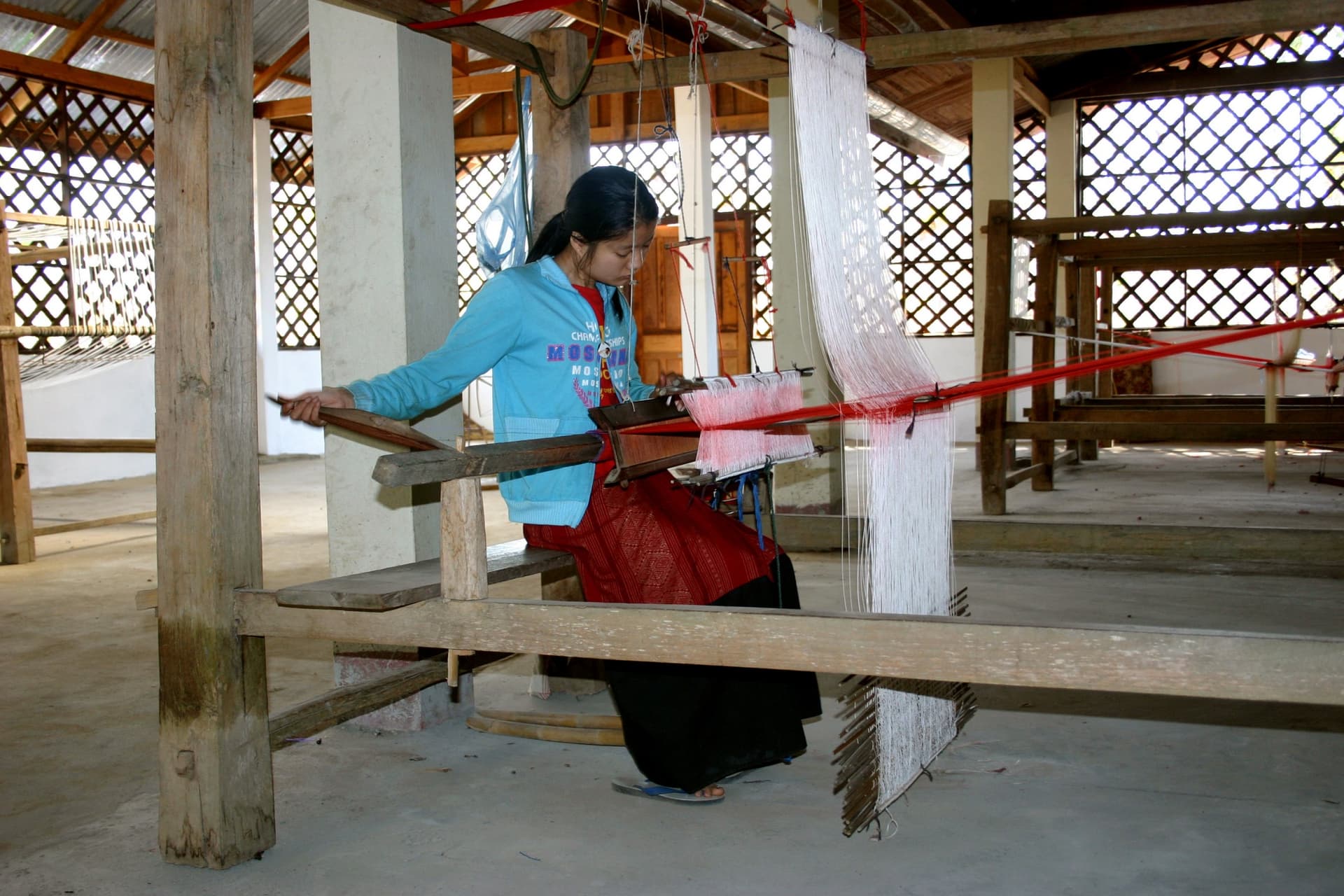
Ban Phanom Village
Ban Phanom Village
Located 4 km from Luang Prabang, Ban Phanom is a weaver's village specializing in silk, cotton, and saa paper—a historic supplier to the royal court.
About 4 km from Luang Prabang, along the Nam Khan River, Ban Phanom is a weaver's village renowned for its silk and cotton work. Its family workshops and artisan cooperative make it a genuine stop for understanding traditional Laotian textiles and their historical connection to the royal court.
Why Visit Ban Phanom
Ban Phanom is not a monumental site but a living village where textile craftsmanship still shapes daily life. The majority of households practice hand weaving, using techniques passed down since the royal era. The village offers three complementary draws:
- Watch weavers at work in their family workshops or at the cooperative.
- Buy directly from artisans—scarves, shawls, stoles, pillowcases, and wall decorations at prices generally lower than those at Luang Prabang's night market.
- Combine your visit with nearby sites: Henri Mouhot's tomb, elephant camp, and Wat Phon Phao temple.
History and Royal Heritage
Ban Phanom long supplied textiles to the monarchy of Luang Prabang. This relationship, documented until the end of the kingdom in 1975, dates back at least to the period following the split of the Lan Xang kingdom in 1707, when Luang Prabang became a distinct realm. The village delivered ceremonial fabrics and everyday cloth to the sovereigns and their court, helping to establish precise technical expertise and pass it down through generations.
This heritage explains the current weavers' attachment to ancestral patterns and methods, which they continue to apply today despite competition from industrial production.
What to See and Do
Silk and Cotton Weaving
The work combines a distinctive approach: thick cotton threads, dyed in various colors, serve as the weft, while silk is used for the patterns. Dyeing, spinning, and weaving are all done by hand on large wooden looms set up beneath stilt houses. Each family tends to preserve its own patterns.
At the village's edge, a cooperative brings together around twenty artisans. It offers short demonstrations and workshops for visitors, and allows you to buy pieces made on-site directly.
Saa Paper
Beyond textiles, Ban Phanom also produces saa paper, traditional Laotian paper made from mulberry bark. It's available as sheets, notebooks, lanterns, and decorative objects—a fine complement to fabric purchases.
Where to Buy
Two main sales points: the village Handicraft shop, which gathers local production, and Luang Prabang's night market, where several stalls sell Ban Phanom pieces. Prices are negotiable in both places, but the range is more favorable at the village.
Practical Information
- Visit duration: allow 1 to 2 hours to explore the village, watch weavers, and make a few purchases.
- Best time of day: morning is quieter for chatting with artisans; tourist crowds peak between 9 and 10 am. Shopping is easier in the morning than evening, when some workshops close.
- Dress code: smart casual recommended—the village is also home to an active temple.
- Payment: cash (kips); bring small bills for family workshops.
How to Get There
Ban Phanom is about 4 km from Luang Prabang's center, on the town's outskirts toward the airport, along the Nam Khan, roughly 2 km from Wat Phon Phao temple.
- By tuk-tuk: about 10 to 15 minutes from the center. Negotiate a round-trip fare with waiting time included; prices are negotiable from the start.
- By bicycle: doable but the road is rough in places. This suits cyclists comfortable with challenging terrain, especially in hot season.
- By private car: easily combined into a half-day itinerary linking Wat Phon Phao, Mouhot's tomb, and a weaving workshop.
Nearby Attractions
- Henri Mouhot's Tomb: this French naturalist, who helped introduce Angkor to Europe in the 19th century, died in Luang Prabang and was buried beside the Nam Khan. His white sepulcher sits in a quiet forested setting, a short distance from the village.
- Wat Phon Phao: a colorful temple perched on a hilltop, about 2 km away, with sweeping views across the region.
- Elephant Camp: located nearby, it offers supervised activities to interact with the animals.
- Nam Khan Riverbank: several bamboo salas set along the river provide shaded rest spots after your visit.
For more excursion ideas outside the city, also explore Nahm Dong Park.
Frequently Asked Questions
Frequently asked questions
Plan for 1 to 2 hours on-site to walk through the village, watch weavers, and shop. Including nearby sites (Wat Phon Phao, Mouhot's tomb), set aside a half-day.
Buying at the village generally yields lower prices and lets you trace a piece's origin. The night market remains convenient if time is short and offers a wider selection in one location.
Morning is best for chatting with artisans and shopping, even though tourist crowds peak between 9 and 10 am. Workshops tend to wind down in late afternoon.
Yes, the village is about 4 km away, but the road is rough in spots. It suits confident cyclists; otherwise, a tuk-tuk is simpler.
The village also produces saa paper, traditional Laotian paper made from mulberry bark, sold as sheets, notebooks, or decorative items.
Fitting Ban Phanom Into a Laos Trip
The village fits naturally into a Luang Prabang stay, complementing city temples and excursions such as Tham Kang Caves or Nahm Dong Park. For a bespoke itinerary blending crafts, temples, and nature, check out our Laos journeys.

Nearby



Interested in this visit?
We can include it in your personalised itinerary.