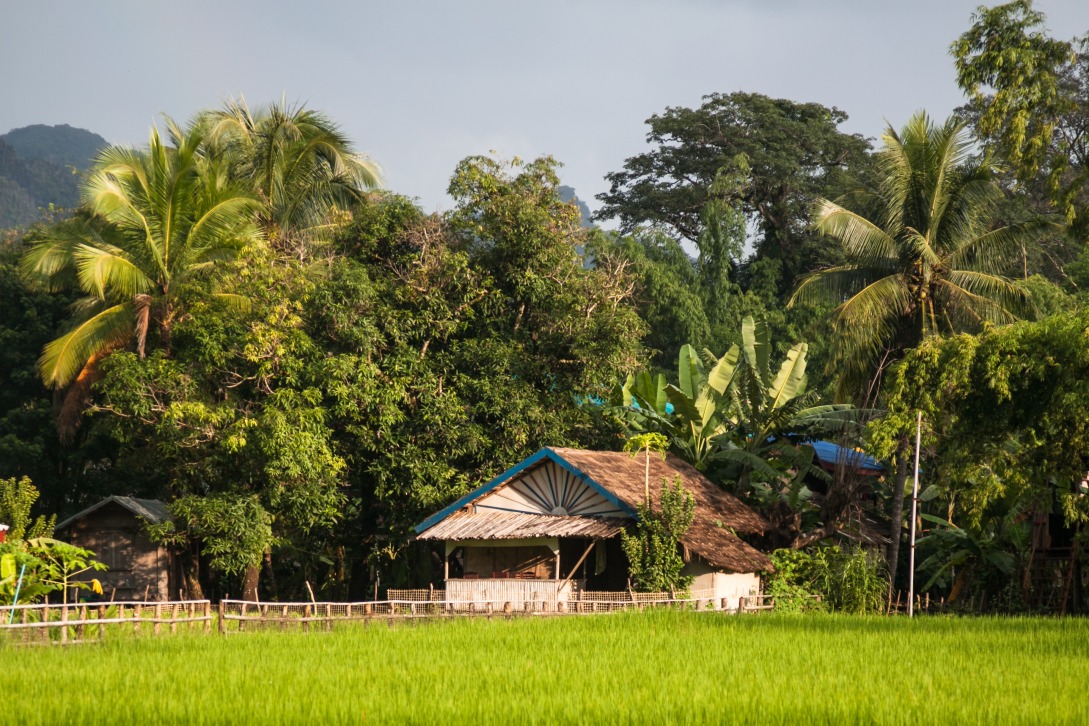
Phou That
Phou That is a sacred hill near Muang Khoun (Xieng Khouang) where an ancient Buddhist stupa overlooks the ruins of a royal city devastated by 20th-century bombing campaigns.
Phou That is a sacred hill located near Muang Khoun, the former capital of Xieng Khouang province in northeastern Laos. Atop the hill stands an ancient Buddhist stupa, a remnant of a royal city devastated by 20th-century bombing campaigns. The site offers sweeping views across the surrounding plain and speaks to the historical depth of a region often reduced in travelers' minds to the Plain of Jars alone.
What You'll See
The partially restored main stupa dominates the hilltop. Around it, brick ruins and scattered Buddhist architectural elements emerge from the vegetation. From the summit, your gaze sweeps across rice paddies and the hills of Xieng Khouang. The atmosphere is peaceful, far from mass-tourism circuits.
History and Context
Muang Khoun served as the capital of the Phuan kingdom, then of Xieng Khouang province, before being nearly obliterated during the Vietnam War (1964–1973). American bombing campaigns flattened the city; only a handful of religious monuments, including Phou That's stupa, partially survived. This context makes the site as much a place of memory as of devotion.
Highlights of Your Visit
The Hilltop Stupa
The Lao-style stupa, erected on a brick foundation, remains the focal point of the site. Its intact silhouette contrasts sharply with the surrounding ruins. Residents of Muang Khoun still come here to leave offerings.
Panorama Across the Plain
From the summit, your eye travels across fields and villages dotting the valley. It's one of the few easily accessible high points in this sector of the province.
The Ruins of Muang Khoun Below
Minutes away on foot, the Wat Phia Wat and other vestiges of the old city round out the experience. Together, they form a coherent circuit through Xieng Khouang's history.
Etiquette and Visiting Rules
- Dress code required: shoulders and knees covered when approaching the stupa.
- Remove your shoes before stepping onto the sacred foundation if instructed on-site.
- Respect offerings and do not disturb them.
Photography Tips
Morning light is most favorable: the stupa is oriented to catch early rays without backlighting. Late afternoon brings a soft haze over the plain, creating evocative panoramic shots. No photography restrictions are known, though discretion is courteous if worshippers are in prayer.
Location and Access
Phou That sits in the immediate vicinity of Muang Khoun (former Xieng Khouang), roughly 30 km southeast of Phonsavan, the current provincial capital. The road between Phonsavan and Muang Khoun is paved and negotiable by car or motorbike. From Muang Khoun, the site is reachable on foot or by tuk-tuk. No accessibility infrastructure is reported on the hill.
Nearby Attractions
- Wat Phia Wat — ruined temple in Muang Khoun, with a partially preserved large seated Buddha.
- Plain of Jars – Site 1 — the province's most accessible megalithic site, roughly thirty kilometers away.
- Phonsavan — the base city for exploring the province, with a market and UXO museum.
Frequently asked questions
The dry season, October through April, ensures passable roads and clear visibility from the summit. During the rainy season, the hill can be slippery.
Yes. Departing from Phonsavan, one day is enough to visit Muang Khoun (Phou That + Wat Phia Wat) in the morning, then head to the Plain of Jars' Site 1 in the afternoon.
The site is freely accessible. An English-speaking local guide from Phonsavan, however, provides valuable context on the war and the history of the Phuan kingdom.
Shoulders and knees covered to respect the stupa's religious significance. Shoes easy to slip off are recommended.
Allow roughly 30 to 45 minutes for Phou That alone, and a half-day if you include the other ruins scattered across Muang Khoun.
Interested in this visit?
We can include it in your personalised itinerary.